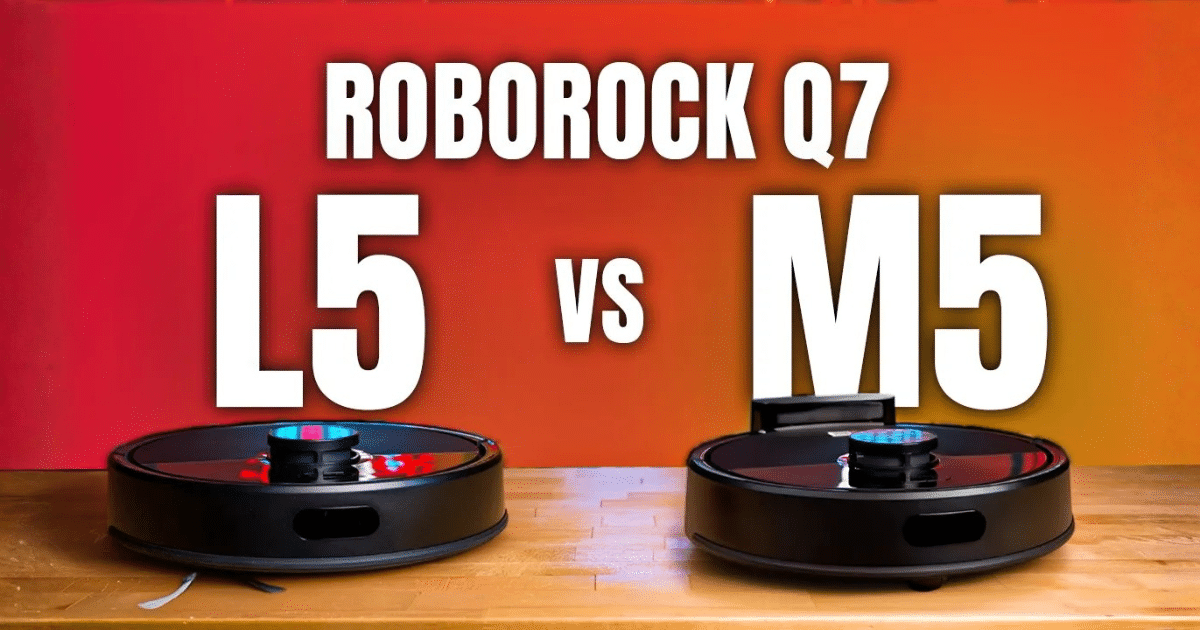
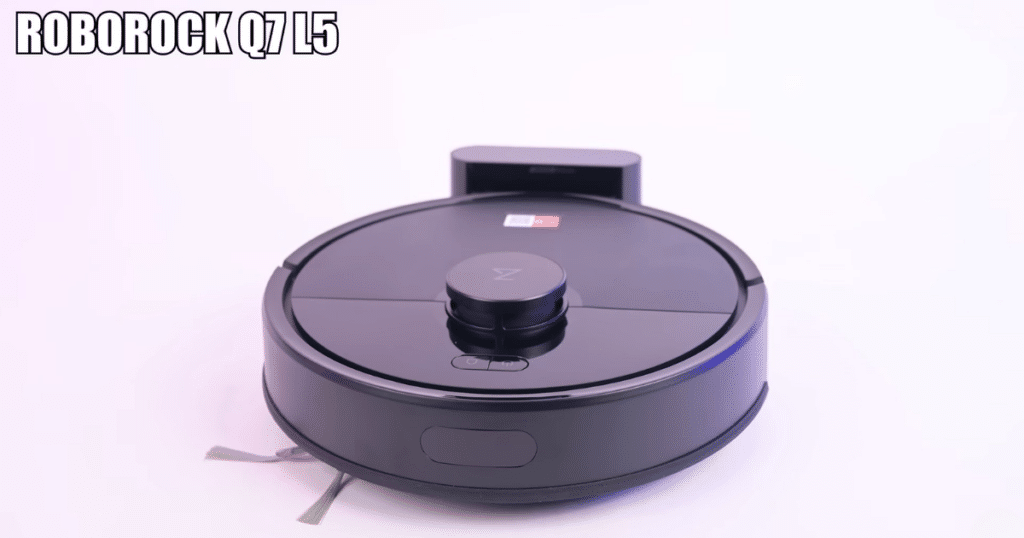
Roborock Q7 L5, Roborock’s latest budget robot vacuum and mop combo, is a follow-up to the extremely popular Q7 M5, which has been topping bestseller lists since its release last year. On paper, the L5 looks very similar to the M5, and after buying both of these robot vacuum and mop combos and putting them through several weeks of testing, we wanted to see whether there were any meaningful differences between them. When we compared the results, we discovered a clear winner between these two closely matched budget robot vacuums.
Our Pick: Roborock Q7 M5
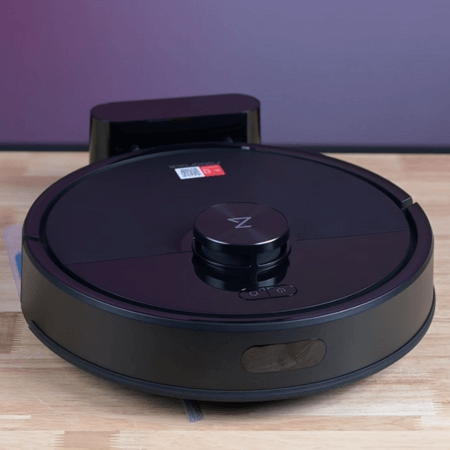
The Roborock Q7 M5 is a strong-performing budget robot vacuum that stands out primarily for its excellent suction and carpet performance. It achieved one of the highest suction scores ever recorded, ranking 14th overall, and performed very well in debris pickup tests on both hard floors and carpets, especially with fine debris. In navigation testing, it scored well above average thanks to its LiDAR system, showing efficient mapping and cleaning paths, while its estimated battery coverage reached about 1,365 square feet per charge, also above average. Its mopping performance was solid, earning an excellent dried stain removal score of 158 while using about twice the average amount of water, resulting in a more balanced outcome than many competitors. On the downside, it was slightly below average in the flattened pet hair test and struggled with hair tangles, with 43% of long hair wrapping around the brush. Additional cons include no mop lifting and only average airflow. Overall, its standout suction, strong carpet cleaning, and reliable navigation make it a top performer for its price. See additional info
Price as of April 1, 2026
Hardware: Removes Hair from Brush Roll
Mopping: Three Adjustable Water Levels
Performance: Carpet Boost Settings
Mapping / Navigation: Multi Level Maps | Virtual Barriers and No Go Zones
| Scores | Roborock Q7 M5 | Average Robot Vacuum Tested |
|---|---|---|
| Vacuum Wars Overall | 2.25 | 2.58 |
| Features | 3.13 | 3.28 |
| Mopping Performance | 2.46 | 2.39 |
| Obstacle Avoidance | 0.0 | 3.39 |
| Pet | 2.64 | 3.42 |
| Navigation | 3.76 | 3.21 |
| Battery | 3.10 | 2.56 |
| Performance | 3.62 | 3.56 |
| Official Battery Life: 150 Minutes | Navigation Type: Spinning Lidar |
| Official Suction Power: 10000 Pa | Dust Bin Size: 400ml |
| Obstacle Avoidance Type: Infrared imaging | Objects Recognized: N/A |
| Multi Level Maps: Y | Virtual Barriers: Y |
| Detergent Capacity: N/A | Disposable Bag: N/A |
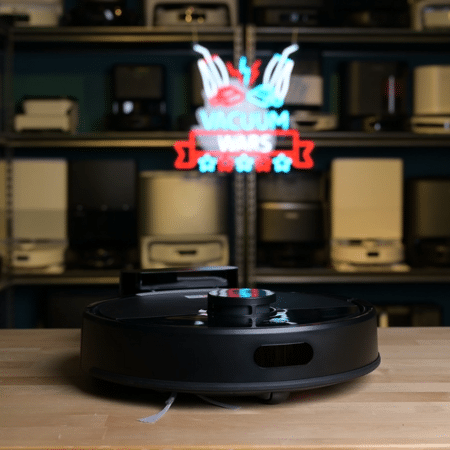
The Roborock Q7 L5 delivers solid performance for a budget robot vacuum, with several standout test results but also notable weaknesses. In suction testing, it performed extremely well—over twice the average—though slightly behind the M5, while airflow was a bit below average but marginally higher than the M5. On hard floors, it handled debris pickup effectively, but it struggled more with fine debris on carpets. In the carpet deep clean test, however, it excelled, removing 80% of embedded sand, which is above average. Navigation was another strong point, with LiDAR-based mapping producing well above-average efficiency scores, though slightly behind the M5. Battery performance was excellent, with an estimated 1,465 square feet per charge—about 300 above average. For mopping, it scored about 128 on dried stain removal (above average) but used over three times the average water, resulting in one of the lowest combined mopping scores recorded. Its weakest results came in hair tests, removing only 12% in the flattened pet hair test and tangling 56% of long hair. Overall, it offers strong suction, navigation, and battery life, but inconsistent carpet and hair performance. See additional info
Price as of April 1, 2026
Hardware: Removes Hair from Brush Roll
Mopping: Three Adjustable Water Levels
Performance: Carpet Boost Settings
Mapping / Navigation: Multi Level Maps | Virtual Barriers and No Go Zones
Controls: Third-Party Voice Control Options
| Scores | Roborock Q7 L5 | Average Robot Vacuum Tested |
|---|---|---|
| Vacuum Wars Overall | 1.75 | 2.58 |
| Features | 2.89 | 3.28 |
| Mopping Performance | 1.88 | 2.39 |
| Obstacle Avoidance | 0 | 3.39 |
| Pet | 1.55 | 3.42 |
| Navigation | 3.82 | 3.21 |
| Battery | 3.33 | 2.56 |
| Performance | 3.48 | 3.56 |
| Official Battery Life: 180 Minutes | Navigation Type: Spinning Lidar |
| Official Suction Power: 8000 Pa | Dust Bin Size: 400ml |
| Obstacle Avoidance Type: N/A | Objects Recognized: 0 |
| Multi Level Maps: Y | Virtual Barriers: Y |
| Detergent Capacity: N/A | Disposable Bag: N/A |
Price and Basic Features
Starting with the basics, both the L5 and the M5 sit at the low end of the robot vacuum market, selling for roughly the same list price of around $250—and often less during sales—making them strong contenders for anyone looking for a robot vacuum under $300.
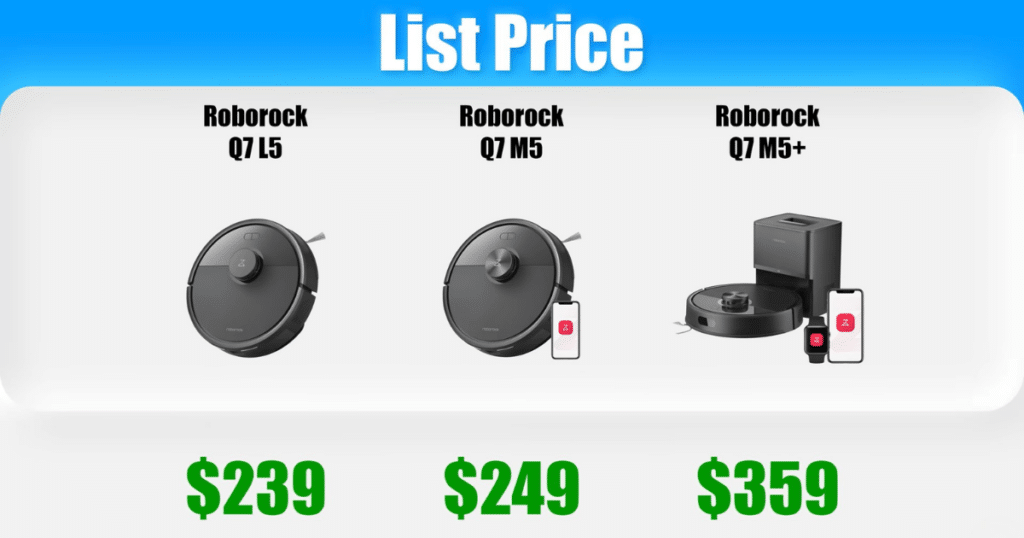
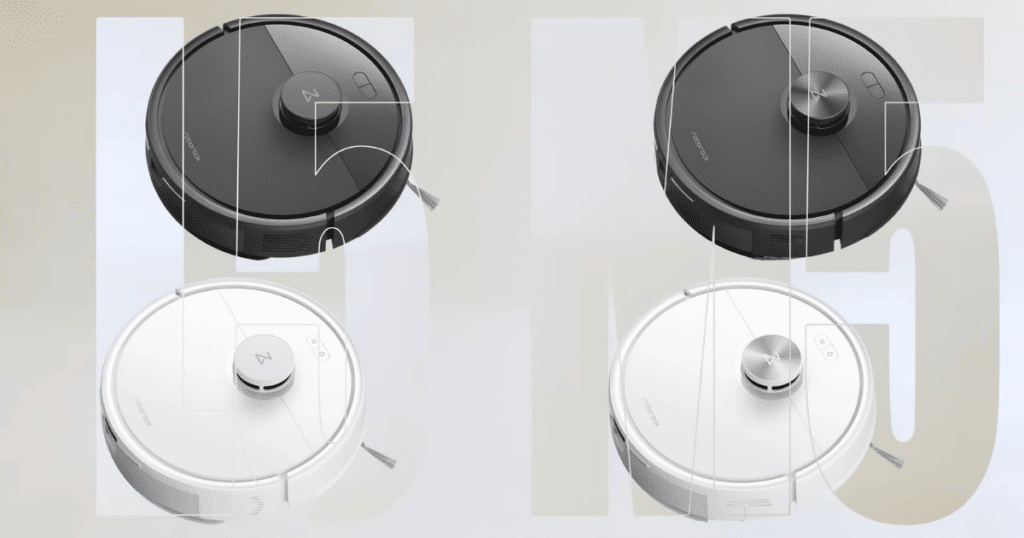
The M5 does have an optional Plus version that includes an auto-empty dock for about $100 more, but the L5 does not offer that option at the time of this writing. Both models are available in either black or white.
Core Design and Everyday Cleaning Performance
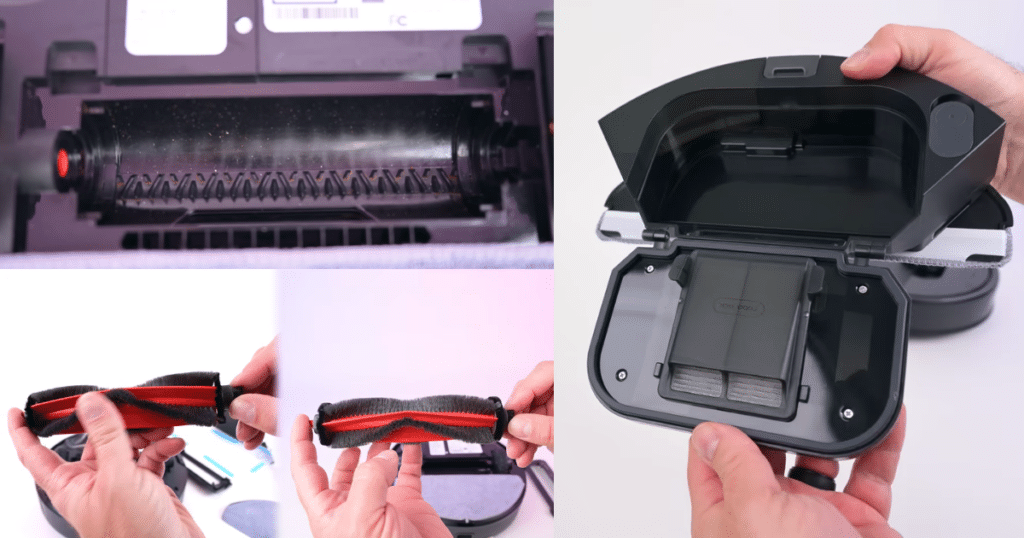
Both robots offer a strong baseline feature set for their price. Each includes a fixed side brush to sweep debris into the suction path, along with the same bristled main brush housed in a floating assembly. That housing includes an active hair removal system, and both units use a 400 ml onboard dustbin.
Top 20 Robot Vacuums
Vacuum Wars’ always up-to-date rankings of the best robot vacuums. Because we purchase every unit ourselves, each recommendation is built on hands-on data. Our work now spans more than 150 models, giving us a deep benchmark for judging cleaning power, navigation smarts, battery life, and advanced features such as obstacle avoidance and mopping.
They also share a similar profile at about 3.9 inches tall (99 mm), and both include Carpet Boost, automatically increasing suction when carpet is detected.
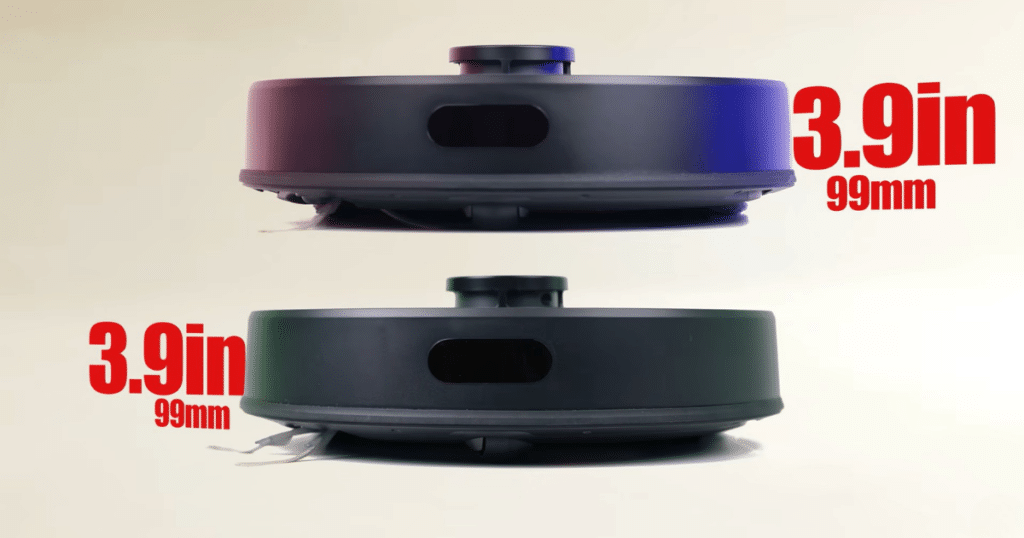
In our basic debris pickup tests on hard floors, both robot vacuums performed well, collecting debris of various sizes with minimal scattering. However, the M5 appeared to do a better job removing fine debris from carpet surfaces during general cleaning.
Carpet Deep Clean Scores
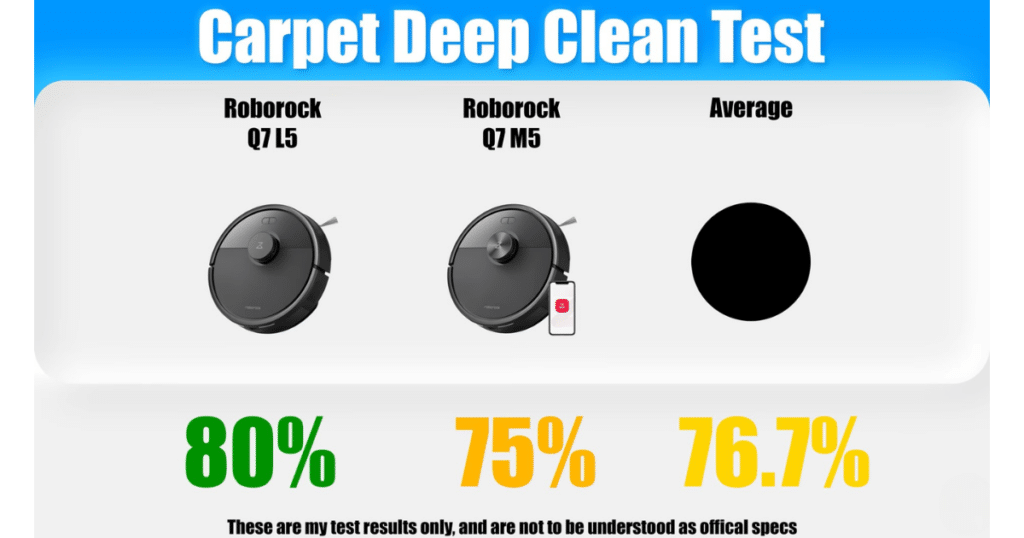
Interestingly, that trend reversed in our carpet deep clean test, where we embed sand into medium-pile carpet and measure removal by weight. In that test, the L5 actually outperformed the M5, removing 80% of embedded debris compared to the M5’s 75%, with the category average sitting at 76.7%.
Roborock Q7 L5: Pros
Roborock Q7 L5 Suction and Airflow
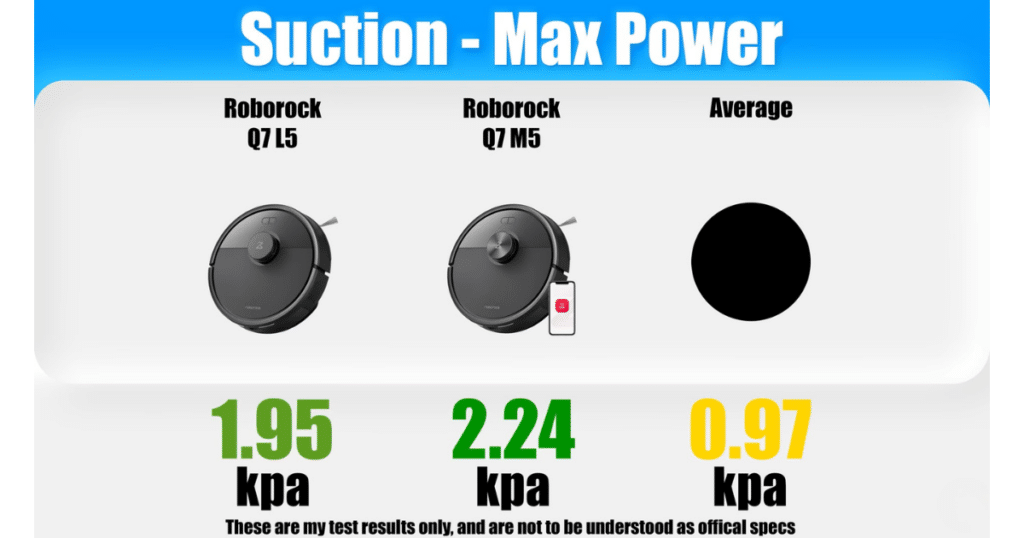
Suction is a strong point for both models. Roborock rates the L5 at 8,000 Pa and the M5 at 10,000 Pa. In our sealed suction bench tests, both robots performed exceptionally well relative to the category average of 0.97 kPa. The L5 achieved 1.95 kPa, while the M5 reached an even higher 2.24 kPa, placing it among the stronger performers we’ve tested overall.
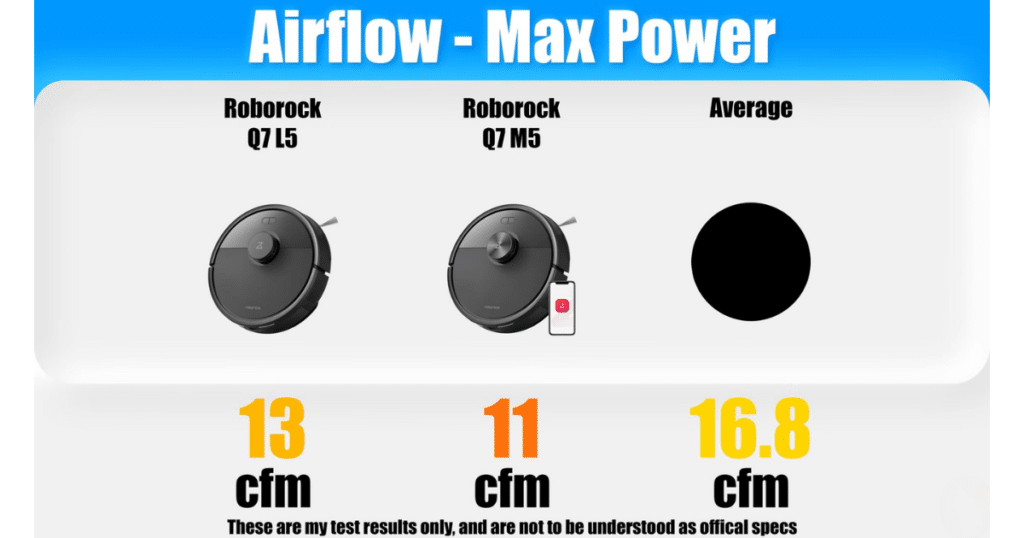
Airflow, however, was below average for both robot vacuums. The L5 measured 13 CFM and the M5 measured 11 CFM, compared to a category average of 16.8 CFM. Even so, the L5 maintained a slight edge in airflow between the two.
Navigation and Battery Efficiency
Neither robot includes a dedicated obstacle avoidance system, but both use top-mounted LiDAR navigation, which we generally prefer compared to embedded lasers due to its reliability and mapping accuracy.
How Vacuum Wars Tests Robot Vacuums: Step into the world of Vacuum Wars, where real-world tests, straight-forward reviews, and no sponsored products redefine robot vacuum evaluations.
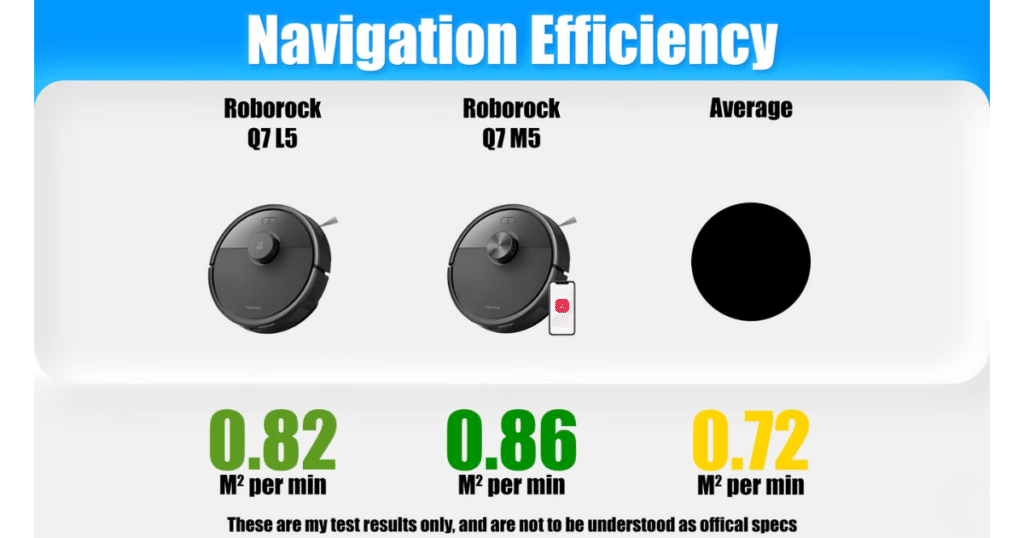
In our navigation efficiency testing, both models performed well above average. The L5 achieved 0.82 square meters per minute, while the M5 slightly outperformed it at 0.86, compared to a category average of 0.72.
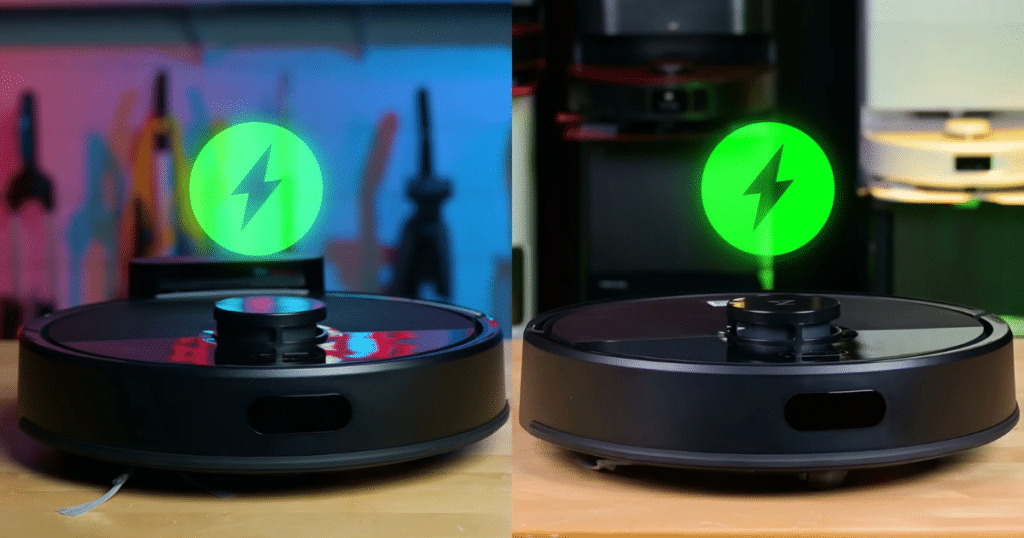
Battery efficiency was another standout category. The L5 delivered 3.33 minutes of runtime per 1% of battery, while the M5 achieved 3.1 minutes per percent. Both exceeded the average of 2.56.
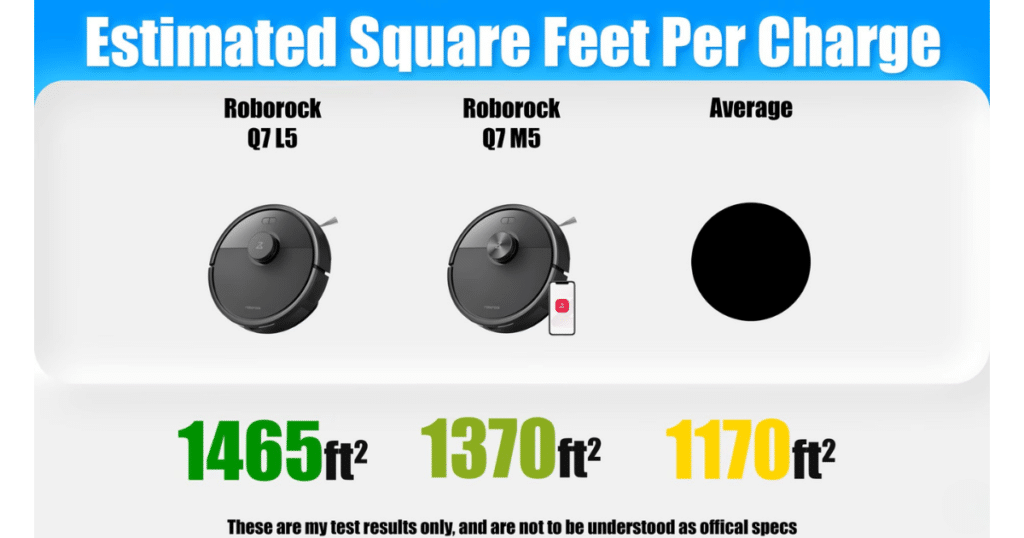
Based on these results, we estimate the L5 can cover about 1,465 square feet per charge, compared to 1,370 square feet for the M5 and an average of 1,170 square feet. Both models also support Recharge and Resume, allowing them to return to the dock, recharge, and continue cleaning automatically.
Roborock App Features and Smart Controls
Roborock’s app remains a major advantage, and both robot vacuums include the same feature set. This includes multi-level mapping, individual room customization, cleaning sequence control, No-Go and No-Mop zones, targeted room or zone cleaning, and integration with third-party voice assistants.
Roborock Q7 L5 Cons
Mopping Features and Performance
Both robots use a basic flat mop pad system with an electronically controlled water tank offering three flow settings.
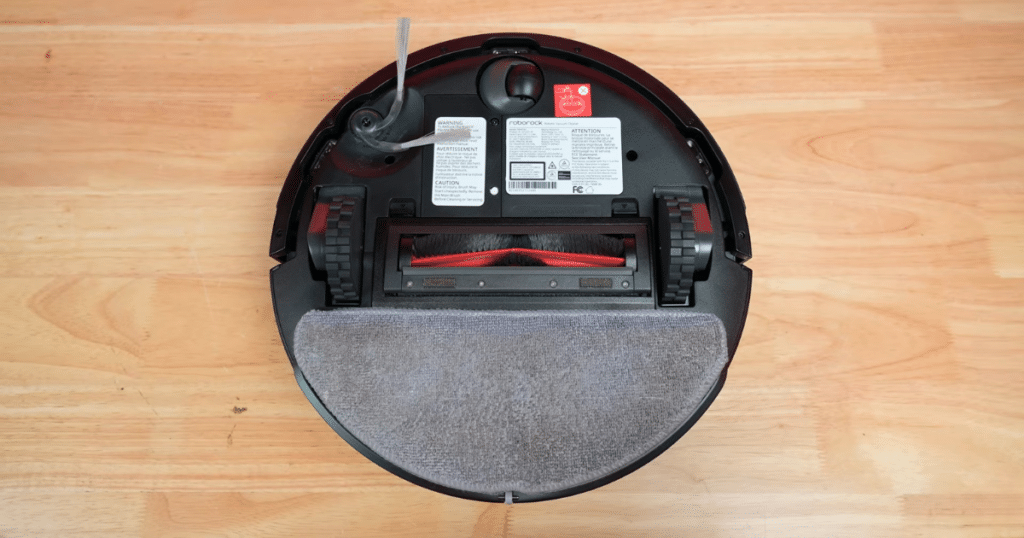
However, the mop pad does not lift over carpet, meaning it must be removed for vacuum-only runs on rugs or carpeted areas.
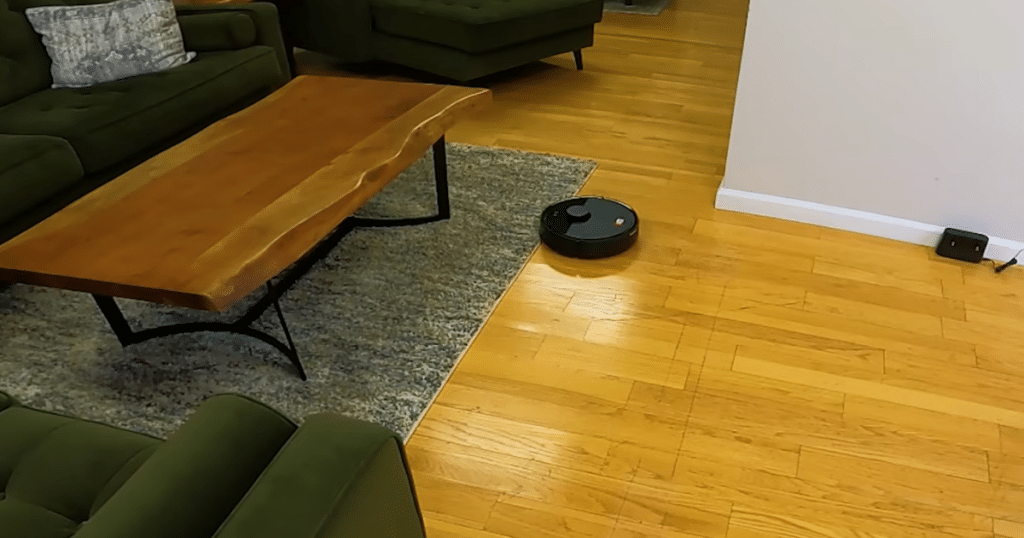
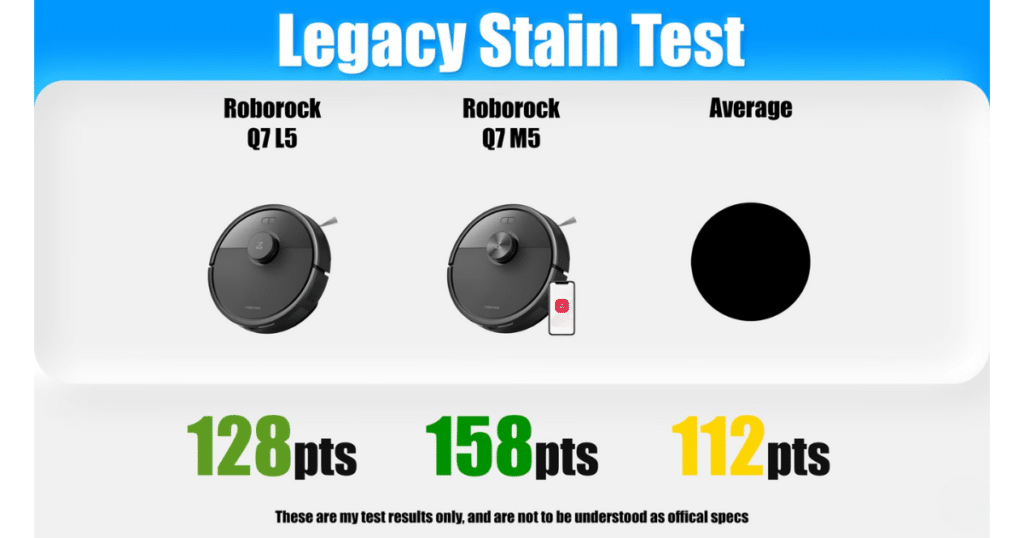
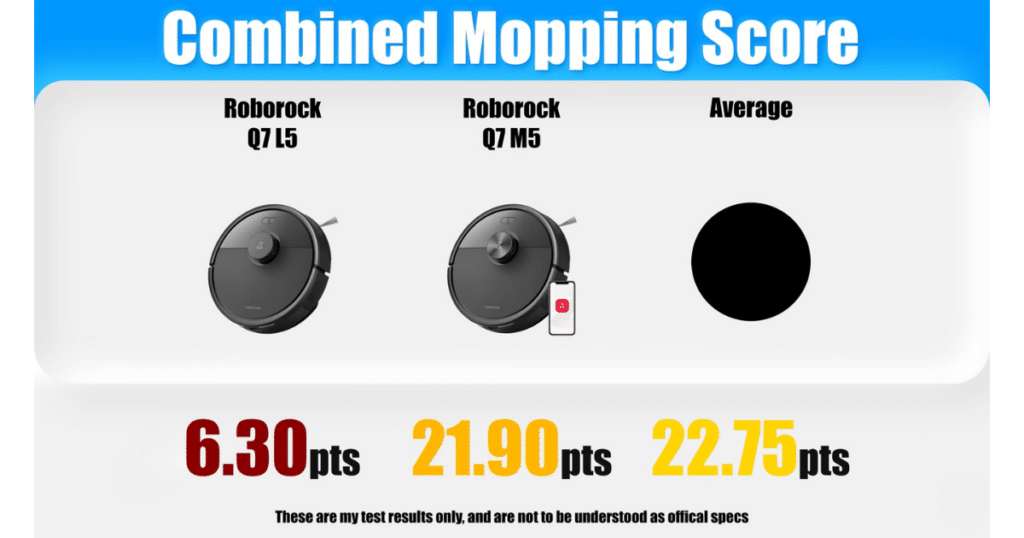
In our mopping tests, we evaluate both stain removal and water usage. The L5 performed above average in dried-on stain removal, scoring 127.5 compared to the average of 112.
However, it used 3.35 grams of water in the process—more than three times the average of 1.04 grams—resulting in overly wet floors and reducing its overall mopping effectiveness. This led to a combined mopping score of just 6.3, the second lowest we have ever recorded.
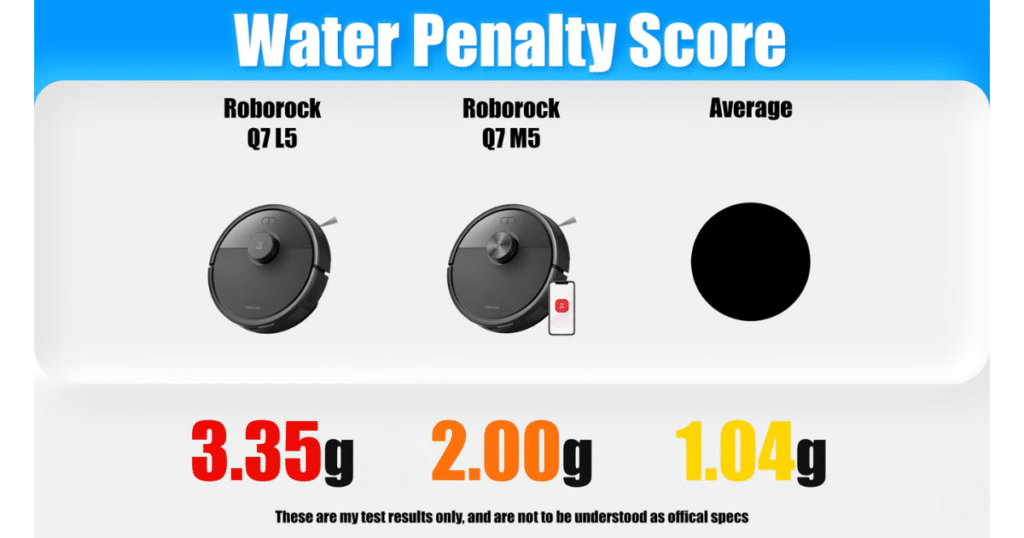
The M5, on the other hand, delivered a stronger and more balanced performance. It achieved an excellent dried stain score of 158 while using 2 grams of water—still above average, but far more controlled than the L5. Its combined mopping score of 21.9 places it much closer to the category average of 22.75.
Pet Hair and Hair Tangle Performance
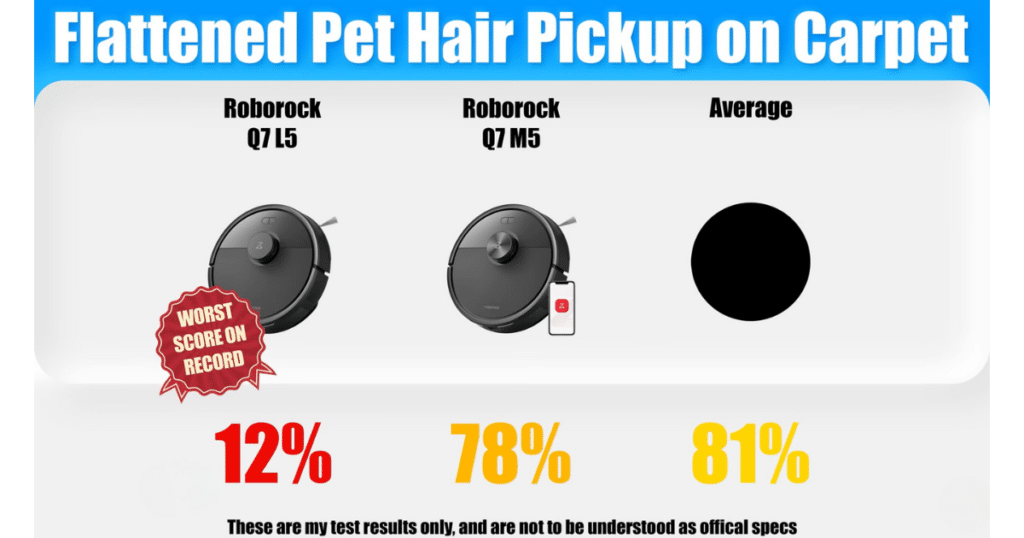
One of the biggest concerns with the L5 appeared in our flattened pet hair test, where we press 2.5-inch hair into carpet fibers. The M5 scored slightly below average, removing 78.5% of the hair compared to the 81% average. However, the L5 performed significantly worse, removing only 12.25%—well below the previous lowest recorded score of 29%. We repeated this test multiple times and saw consistent results, so we have to treat this as a legitimate weakness.
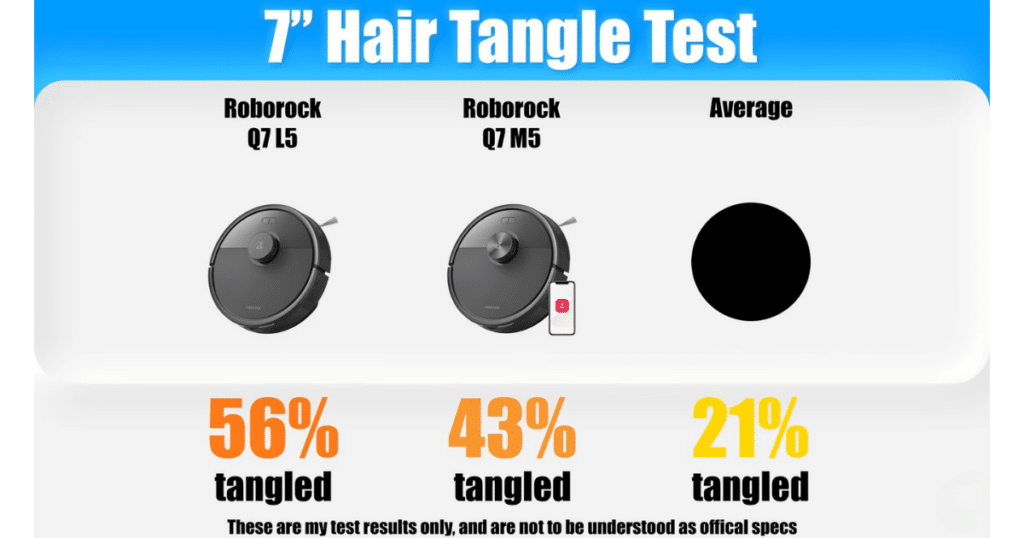
Hair tangle performance was another weak point for both models. In our 7-inch hair tangle test, the M5 had 43% of hair wrap around the brush, while the L5 performed even worse at 56%, compared to a 21% average. Despite the inclusion of Roborock’s “jaw scraper” comb system, neither robot vacuum handled long hair particularly well in our testing.
Final Verdict: Q7 L5 vs Q7 M5
When we looked at all the results together, the Roborock Q7 M5 was the clear winner. While the Q7 L5 had some strengths, including slightly better carpet deep cleaning, airflow, and battery efficiency, those advantages were outweighed by its significant weaknesses—particularly in pet hair pickup, hair tangling, and mopping performance.
The Q7 M5 delivered more consistent results across categories, with better mopping performance and stronger overall carpet cleaning in real-world conditions. When you also factor in the availability of the optional auto-empty dock with the Q7 M5 Plus version, it becomes the more versatile and practical choice.
In terms of ranking context, both models remain competitive options in the budget robot vacuum category, especially for shoppers looking for a robot vacuum under $300. However, the Roborock Q7 M5 stands out as the better overall performer and the one we would recommend for most households.
Compare Roborock Q7 Series Robot Vacuums
See how these budget robot vacuums stack up against each other. Select a model comparison below to view details. You can also compare additional models using our robot vacuum comparison tool.
Frequently Asked Questions
Which is better: Roborock Q7 L5 or Q7 M5?
The Roborock Q7 M5 is the better overall robot vacuum. While the Q7 L5 performed slightly better in carpet deep cleaning and battery efficiency, the Q7 M5 delivered more consistent results across categories, especially in mopping performance, pet hair pickup, and overall carpet cleaning.
Is the Roborock Q7 L5 worth buying?
The Roborock Q7 L5 may be worth considering if found at a significantly lower price, particularly for basic cleaning tasks. However, its extremely low pet hair pickup score and poor mopping performance make it a less reliable choice compared to similarly priced alternatives like the Q7 M5.
How good is the Roborock Q7 M5 for carpet cleaning?
The Roborock Q7 M5 performs well on carpets overall, especially in real-world cleaning scenarios. While it scored slightly below average in carpet deep cleaning at 75%, it handled surface debris and fine particles more effectively than the Q7 L5 in day-to-day use.
Do the Q7 L5 and Q7 M5 have obstacle avoidance?
No, neither the Q7 L5 nor the Q7 M5 includes a dedicated obstacle avoidance system. However, both use top-mounted LiDAR navigation, which provides accurate mapping and efficient cleaning paths.
Can the Roborock Q7 M5 auto-empty?
Yes, the Roborock Q7 M5 is available in a Plus version that includes an optional auto-empty dock. The Q7 L5 does not currently offer an auto-empty dock option.
Are these good robot vacuums under $300?
Yes, both the Roborock Q7 L5 and Q7 M5 are strong contenders in the robot vacuum under $300 category. However, the Q7 M5 is the better value overall due to its more balanced performance and additional upgrade options.
Roborock Q7 M5
Roborock Robot Vacuum Buyer’s Guide 2025
If you’re overwhelmed by Roborock’s sprawling lineup, you’re not alone. This guide distills the key differences among each series—Q, S, Qrevo, and Saros—so you can decide which features are worth paying extra for and which you can skip. From budget-friendly models to premium robots with cutting-edge capabilities, we’ll help you focus on the must-know points and find a Roborock that fits both your home and your wallet. See the Guide