Vacuum Wars is reader supported. When you make a purchase using links on our site we may earn a commission. Details.

MOVA S10 Robot Vacuum Review — Budget LiDAR Robot Vacuum With Mopping

We recently named the MOVA S10 our favorite option in its price range. It’s often available for under $200, while many flagship robot vacuum/mop combos sell for several times that. The broader story is how much the budget category has improved. For much of Vacuum Wars’ history, the Roomba 600 series set the baseline in the entry-level tier. Today, you can get a more feature-rich experience for similar money—especially in navigation and mopping. In this review, we compare the MOVA S10 to the Roomba 600 series to show what’s changed.”
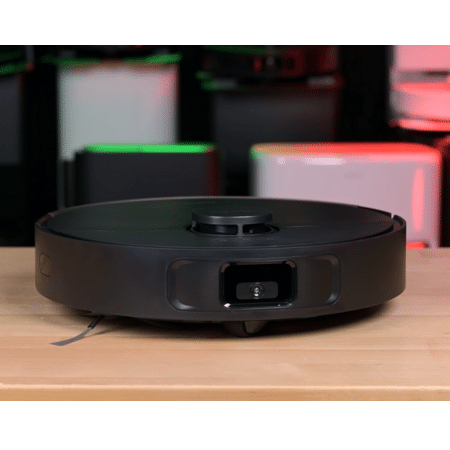
MOVA S10 Robot Vacuum Mop we purchased for evaluations at the Vacuum Wars studio

The MOVA S10 robot vacuum and mop combo impressed us in testing while also packing in some strong headline specs. It uses top-mounted LiDAR to map your home and clean in neat, efficient rows, and combines that with a 7000Pa suction port that’s marketed as especially effective for pet owners, picking up debris and pet hair on both hard floors and carpets without tangling. In our tests, it earned one of the best carpet deep-clean scores we’ve seen at 90%, which is remarkable at this price point. The S10 intelligently detects surfaces, raising its mops by 7 mm to protect carpets from moisture during vacuuming, and the app allows you to adjust suction, patterns, schedules, and create multiple maps and no-mop zones. Overall, the combination of strong performance, modern mapping, and pet-friendly suction makes the MOVA S10 an excellent entry into the world of robot vacuums. See additional info


Price as of January 2, 2026

Mopping: Lifts Mop Pad on Carpets | RoboSwing Technology for Hard to Reach Areas

Hardware: 20mm Threshold Crossing

Performance: Carpet Boost Settings

Mapping / Navigation: Multi Level Maps | Virtual Barriers and No Go Zones

Controls: Third-Party Voice Control Options

ScoresMova S10Average Robot Vacuum Tested
Vacuum Wars Overall2.98

2.58

Features3.28

3.28

Mopping Performance2.41

2.39

Obstacle Avoidance0.83

3.41

Pet3.05

3.42

Navigation4.66

3.21

Battery5.0

2.56

Performance4.18

3.56

Official Battery Life: 260 MinutesNavigation Type: Spinning Lidar
Official Suction Power: 7000 PaDust Bin Size: 350ml
Obstacle Avoidance Type: 3D Structured LightObjects Recognized: 0
Multi Level Maps: YesVirtual Barriers: Yes
Detergent Capacity: N/ADisposable Bag: N/A

Overview: MOVA S10 Robot Vacuum and Mop Combo

The MOVA S10 comes in two package options. There’s a version with an auto-empty dock called the S10 Plus, which we’ve reviewed, though it’s harder to find. And there’s the standard MOVA S10 package, which includes the robot vacuum and charger. We’ll focus on the standard package in our MOVA S10 review.
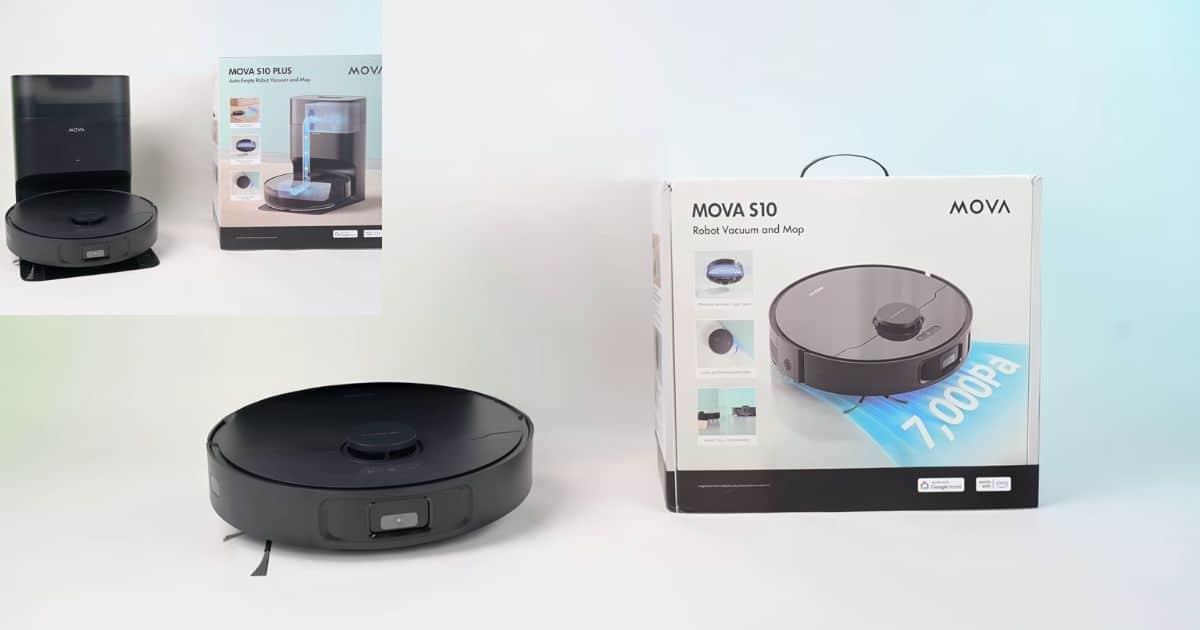
Studio photo showing the MOVA S10 robot vacuum in front of its retail box labeled “MOVA S10 Robot Vacuum and Mop” with a blue “7,000Pa” suction graphic. There’s also an inset image of the MOVA S10 Plus auto-empty robot vacuum and dock alongside its “MOVA S10 Plus Auto-Empty Robot Vacuum and Mop” packaging.
The standard MOVA S10 we tested, with the S10 Plus auto-empty version shown in the inset. © Vacuum Wars

Navigation: LiDAR Mapping vs. Random Movement

Navigation is one of the biggest differences between the MOVA S10 and the Roomba 600 series. The S10 has smart navigation with a top-mounted LiDAR sensor, allowing it to map your floor plan and vacuum in straight, efficient rows. It knows where it has been and where it hasn’t, which is one of the biggest advancements in modern robot vacuums.
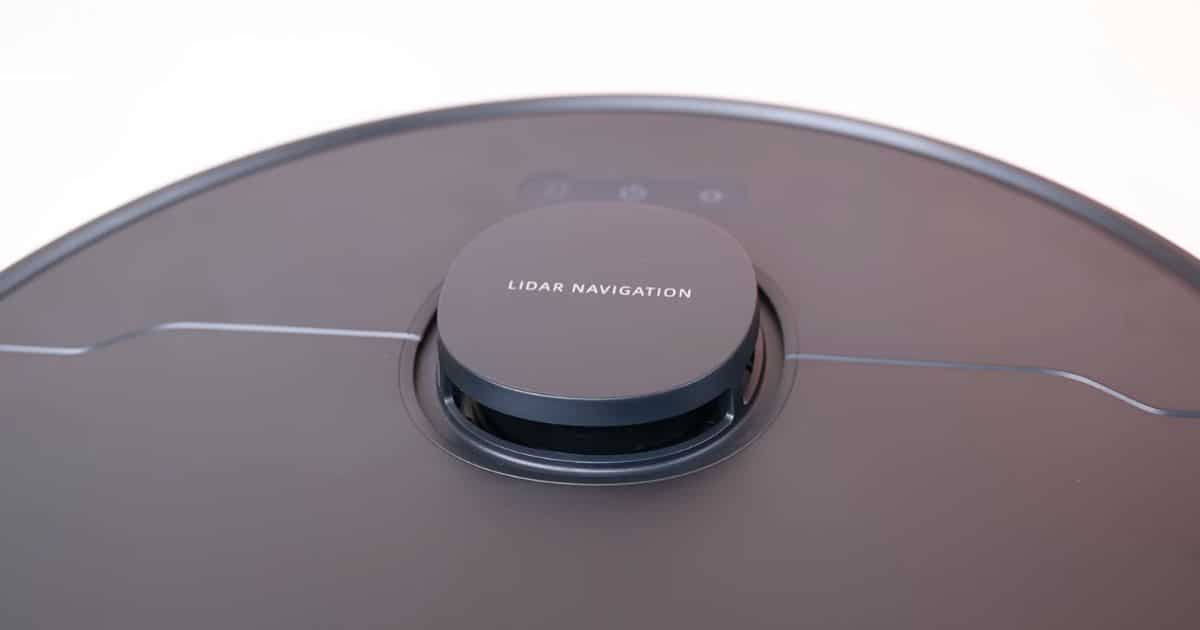
Close-up of the MOVA S10’s top-mounted lidar sensor module, labeled “LIDAR NAVIGATION,” centered on the robot vacuum’s dark housing.
Close-up view of the S10’s LiDAR turret that drives its smart navigation. © Vacuum Wars

In contrast, the Roomba 694 uses random navigation. That means it bounces around until its battery runs low. Sure, it covers space reasonably well for the time, but it can miss rooms. It’s also inconsistent and doesn’t create a map. So you miss out on many important app features that the S10 offers.
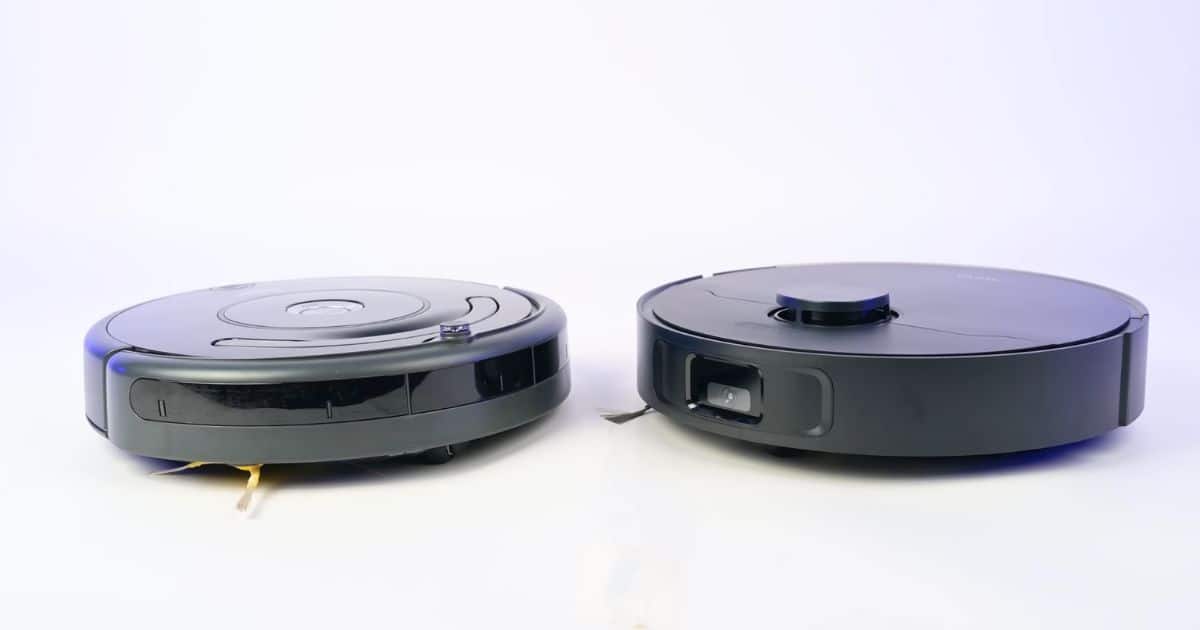
Side-by-side studio photo of a Roomba 600 series robot vacuum on the left and the MOVA S10 robot vacuum on the right, showing the different body designs and front sensor layouts on a white background.
Design and sensor layout differences between the Roomba 600 series (left) and the MOVA S10 (right). © Vacuum Wars

Mopping Features: Vibration, Carpet Lift, and Evaluation Results

Another major difference is that the MOVA S10 includes a mop. It has a single vibrating mop pad (VibroTurbo) with 3.5N of pressure. It includes RoboSwing, electronically controlled water flow, and one standout feature: it can lift its mop pad by 7mm whenever it detects carpet.

This keeps carpets dry and allows for vacuuming and mopping mixed floor plans in the same run. These mopping features are typically found on robots priced between $600 and $1,000.
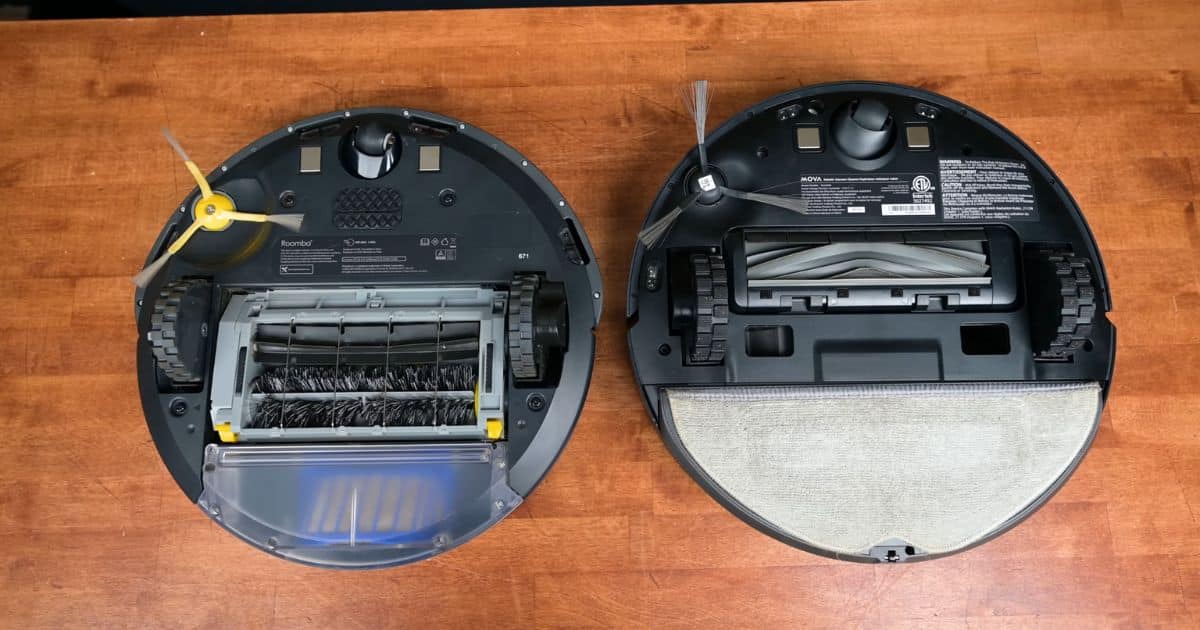
Top-down view of the undersides of two robot vacuums on a wood surface used for our MOVA S10 review: the Roomba 600 series on the left with dual brush rolls and a yellow side brush, and the MOVA S10 on the right with a single rubber main brush, side brush, and an attached mopping pad.
Both robot vacuums share a fairly similar design, yet the MOVA S10 offers much more, including mopping and mapping. © Vacuum Wars

In our mopping evaluations, the MOVA S10 performed really well. It scored 115 points (average is 112) in our dried-on stain assessment.
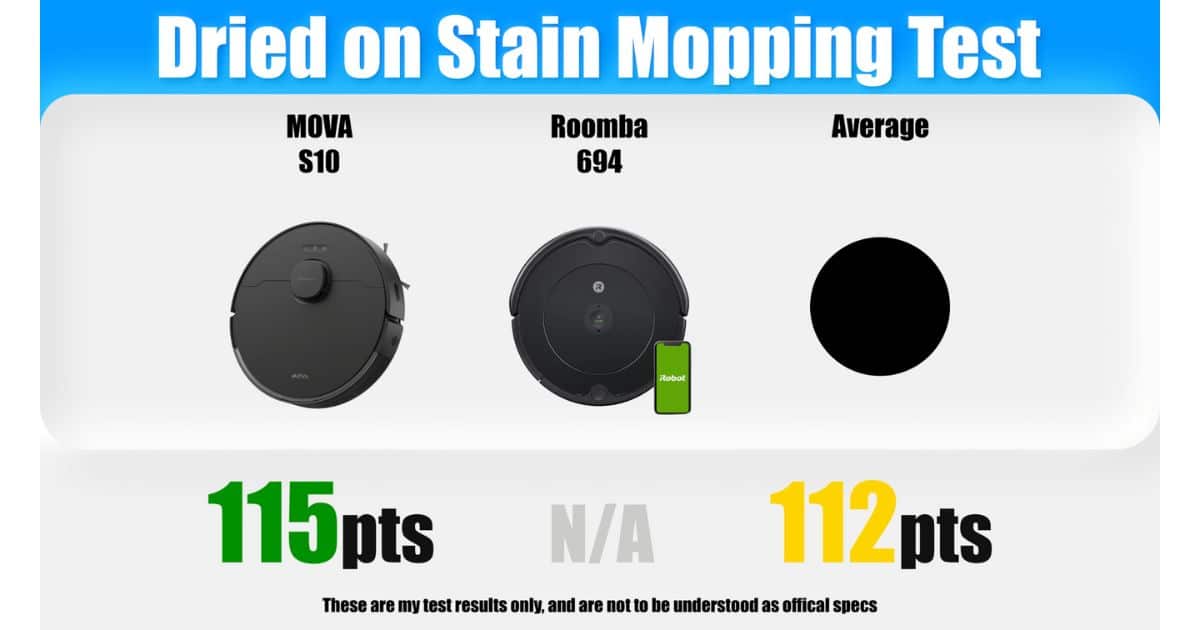
Comparison graphic titled “Dried on Stain Mopping Test” showing the MOVA S10 with a score of 115 points, the Roomba 694 with N/A, and an average score of 112 points.
S10 is just above average in dried-on stain mopping. © Vacuum Wars

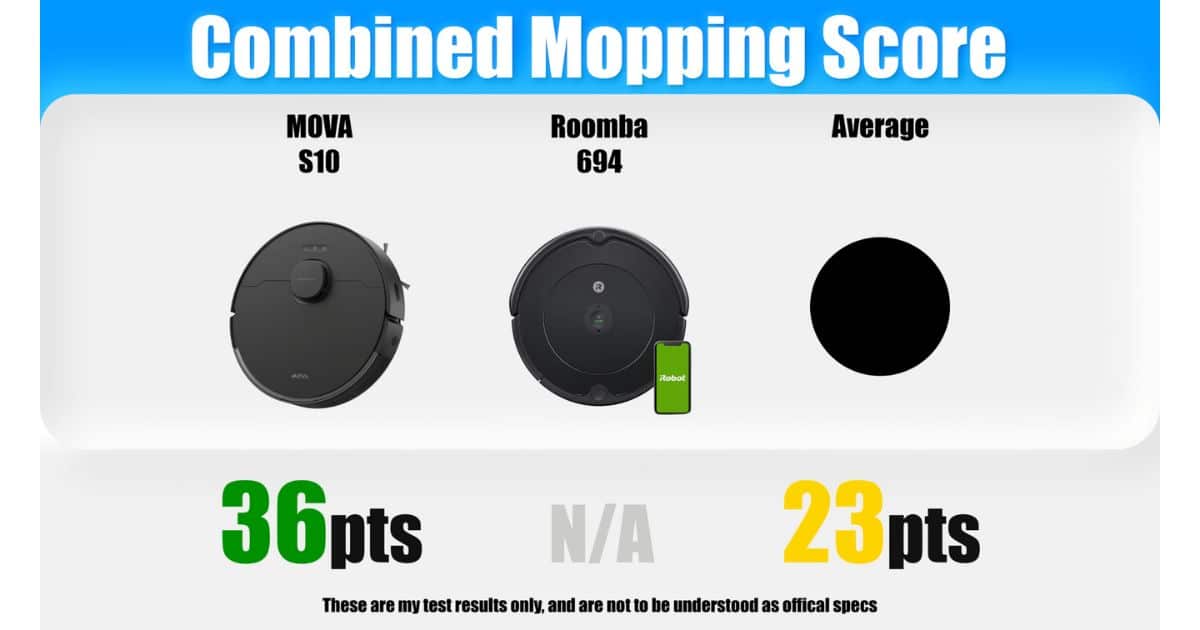
It also left very little water behind—just .20 grams, compared to the 1.04-gram average. And its combined mopping performance score was 36 points, which is well above the 23-point average. All of this is impressive for the price point, and remember: the Roomba 600 series and most competitors in this price range don’t mop at all.
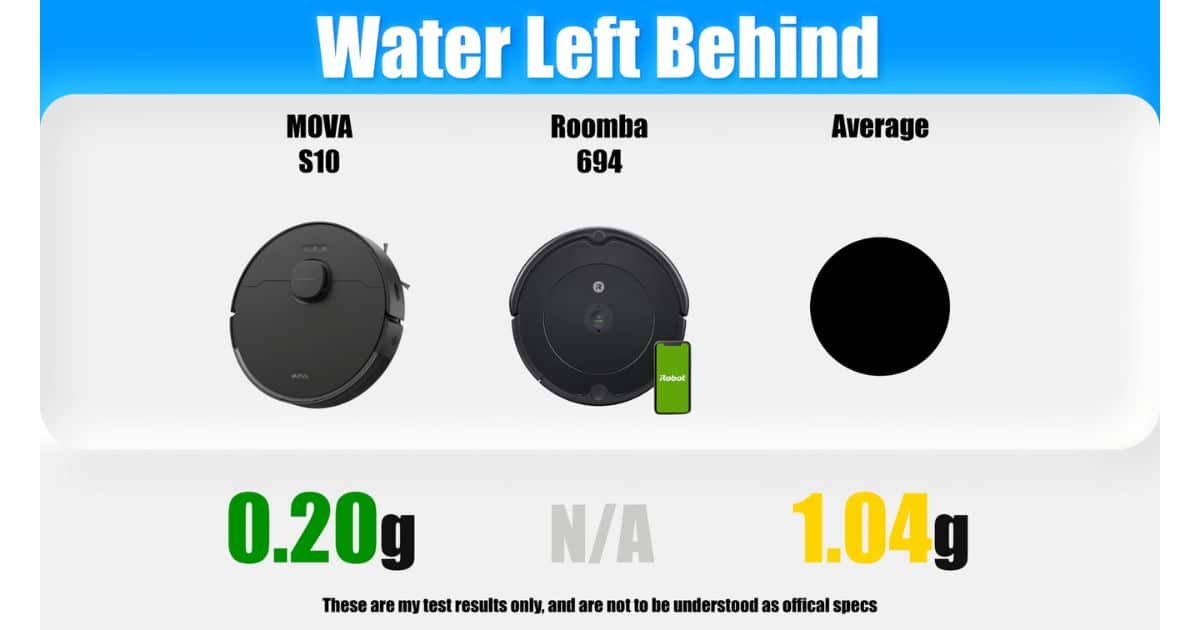
Comparison graphic titled “Water Left Behind” showing the MOVA S10 with 0.20 g of water left, the Roomba 694 listed as N/A, and an average of 1.04 g left behind.
S10’s low 0.20 g water-left-behind score beats the 1.04 g average. © Vacuum Wars
Comparison graphic titled “Combined Mopping Score” showing the MOVA S10 with 36 points, the Roomba 694 with N/A, and an average mopping score of 23 points.
The S10’s combined mopping score sits well above the category baseline. © Vacuum Wars

Obstacle Avoidance Performance

The MOVA S10 includes front-mounted obstacle avoidance using 3D structured light sensors, something almost unheard of at this price range. In contrast, the Roomba 600 series has no such sensors. But the S10’s obstacle avoidance performance was below average. It avoided only 4 of 24 objects compared with an average of 17 in our evaluations.
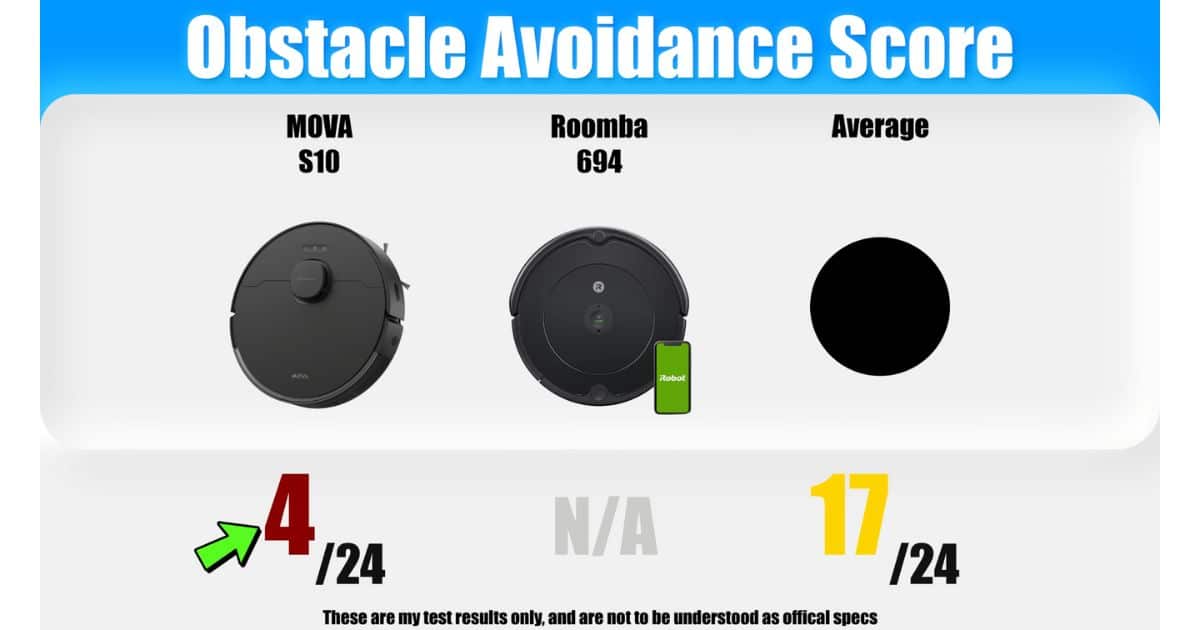
Obstacle avoidance score graphic comparing MOVA S10, Roomba 694, and the average; the MOVA S10 is rated at 4 out of 24 obstacles avoided, Roomba 694 is marked N/A, and the average robot shows 17 out of 24.
S10 avoided 4 of 24 objects, which is well below the 17/24 average. © Vacuum Wars

Still, because the S10 creates a map, you can set virtual barriers in the app. That’s something you can’t do with the Roomber 600 series.
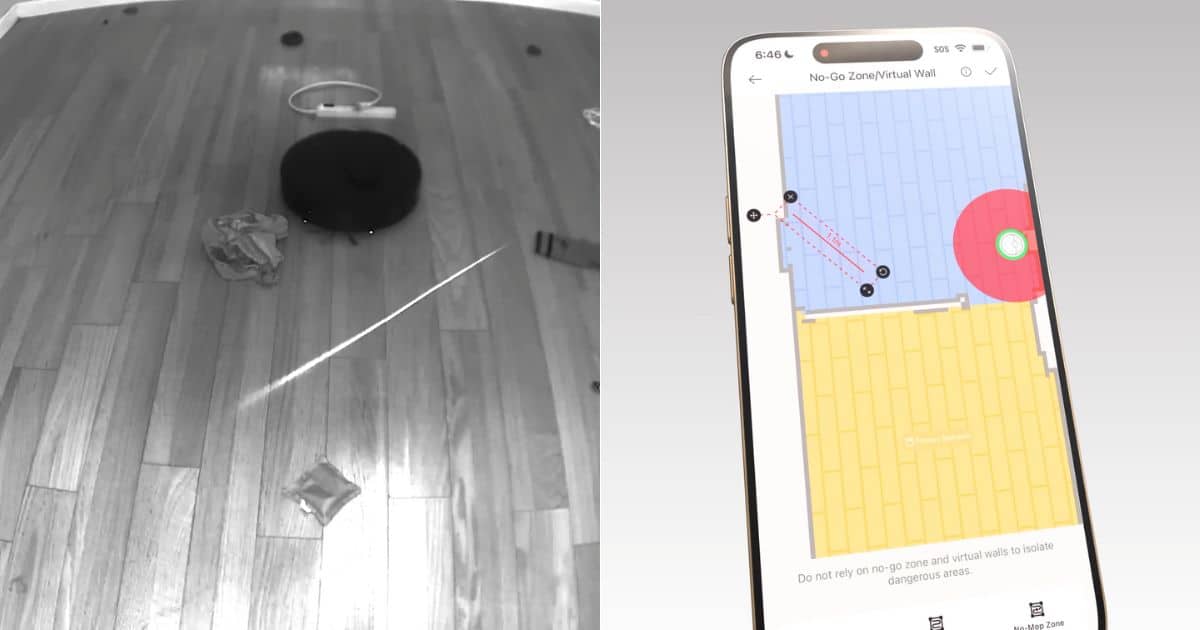
Split image showing an overhead view of the MOVA S10 navigating an obstacle course with socks and other items on a hardwood floor on the left. On the right, a smartphone screen with the MOVA S10 app open to a floor map with colored rooms and virtual no-go zones and walls.
You can set digital no-go zones with the MOVA S10 to improve your overall experience. © Vacuum Wars

Vacuuming Performance: Airflow, Suction, and Brushes

When it comes to vacuuming, the two robots are closer, but the S10 still pulls ahead in most categories. It had significantly more airflow at 20 CFM than the Roomba 694’s 9 CFM (average is 17 CFM).
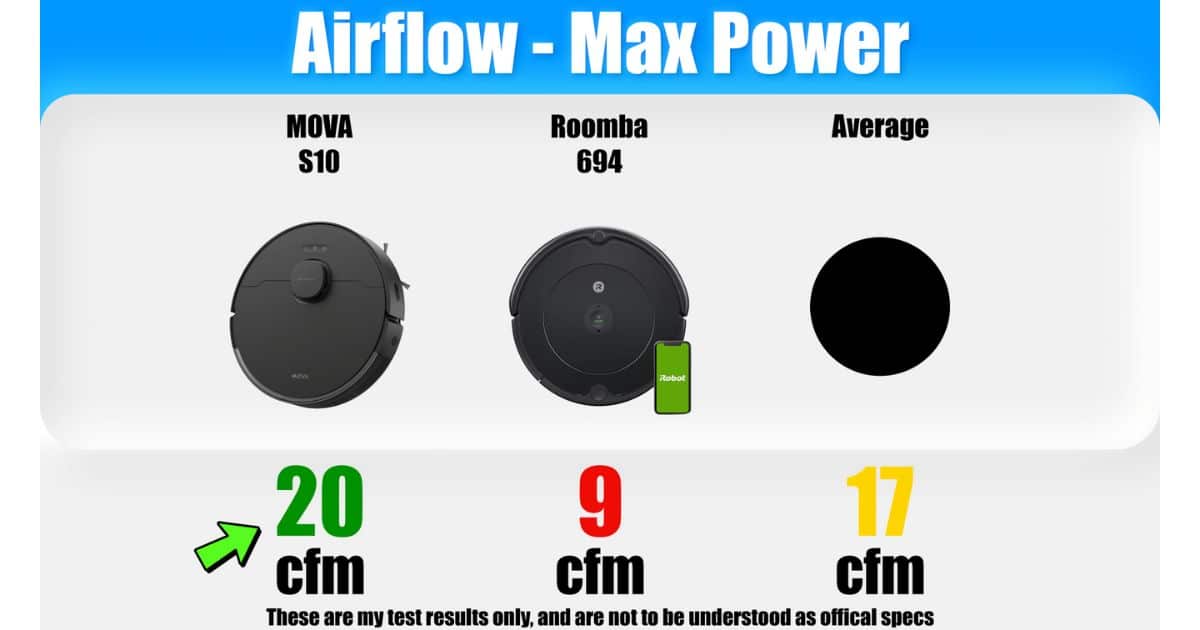
Airflow-at-max-power graphic comparing the MOVA S10 at 20 CFM, Roomba 694 at 9 CFM, and the average robot at 17 CFM.
Roomba 694’s 9 CFM placed it well below the average score. © Vacuum Wars

For suction, the S10 measured 0.87 kPa compared with the Roomba’s 0.06 kPa. The category average is around 0.97 kPa. However, both did well at picking up debris from hard floors and carpets.
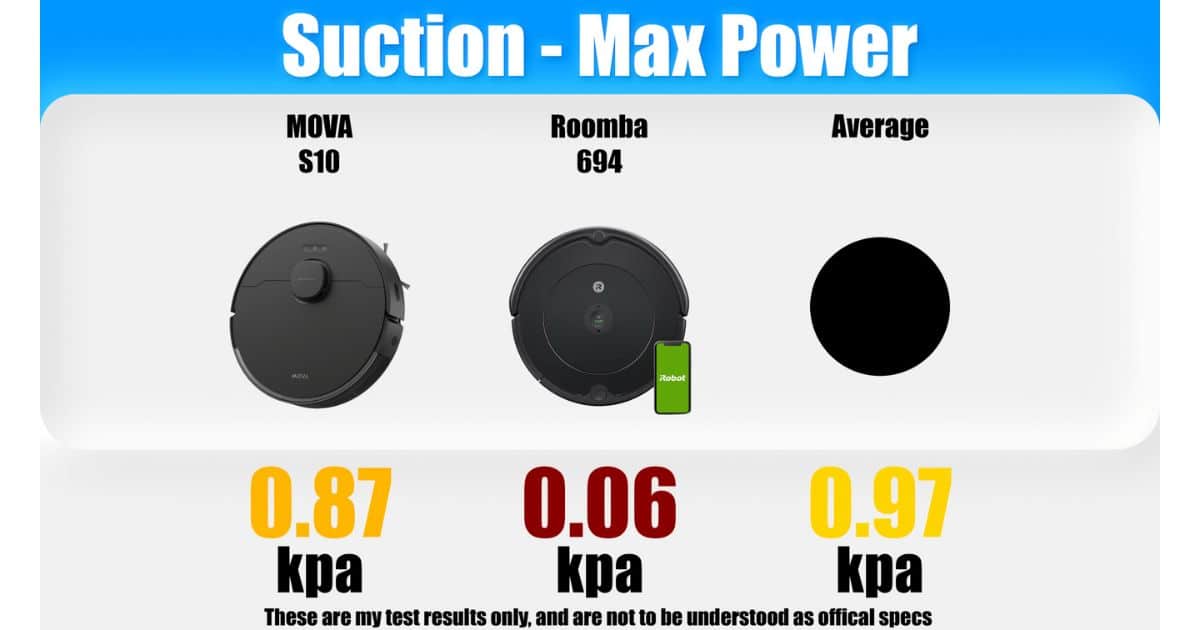
Max power suction comparison for the two robots and the test average, showing the MOVA S10 measured at 0.87 kPa, the Roomba 694 at 0.06 kPa, and the average robot at 0.97 kPa.
A sizable gap between the S10 and the 694 on maximum pull. © Vacuum Wars

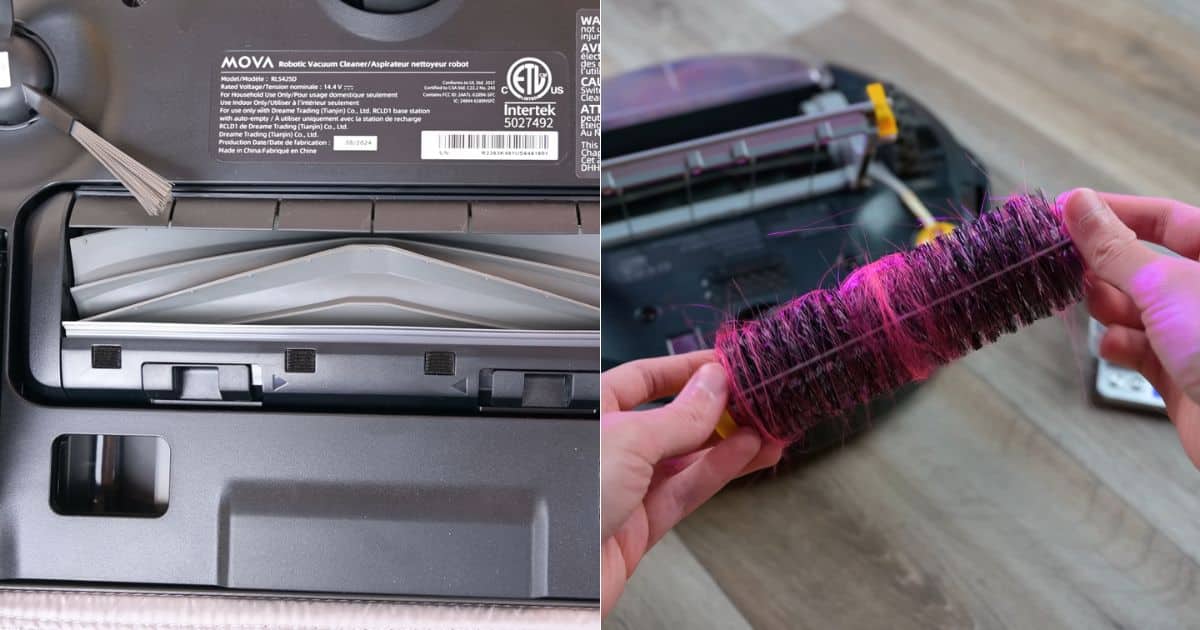
The S10 uses a single-sided brush and a single rubberized main brush, while the Roomba 694 uses a dual-brush system. One of them has old-style bristles, and it’s one of the few robot vacuums still using that type. It hurt the Roomba’s hair-tangle performance.

Hair Tangle and Deep Cleaning Results

In our 7-inch hair tangle evaluation, the S10 had a good score with only 28% of the hair getting caught in its roller—slightly above average. The Roomba, by contrast, had nearly 100% of the hair caught in its rollers, which is the worst score ever recorded.
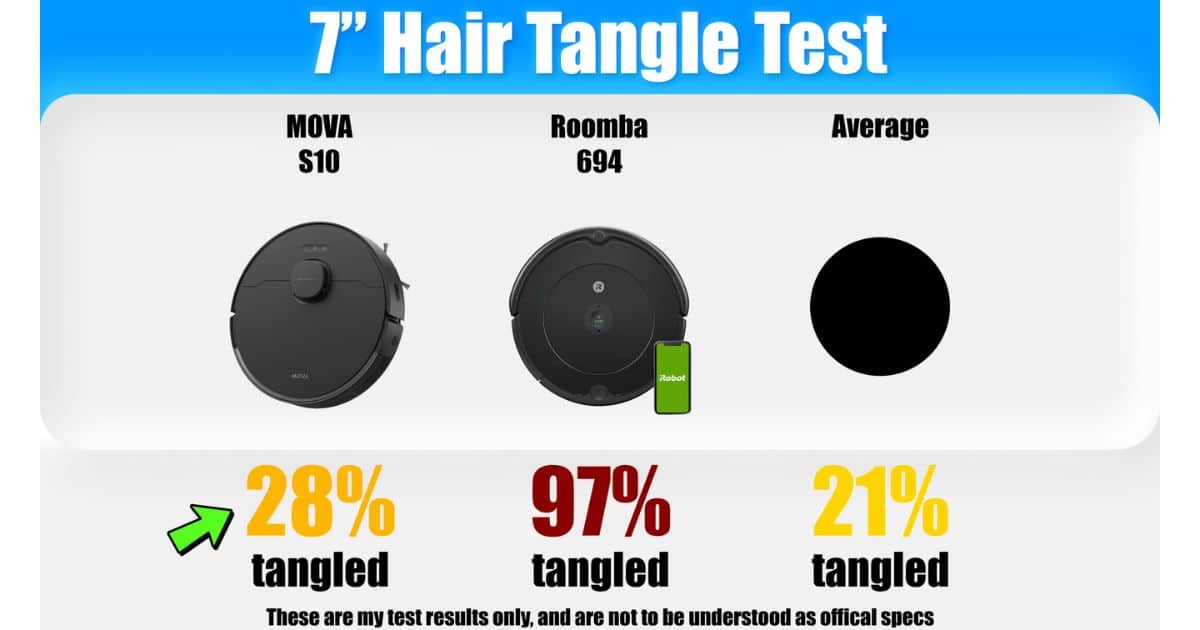
7-inch hair tangle chart where the MOVA S10 ends up with 28% of the hair tangled in its brush, the Roomba 694 has 97% tangled, and the average robot registers 21% tangled.
The 694 can be strong at picking up pet hair, yet its brush design led to far heavier tangles than the S10’s rubber roller. © Vacuum Wars
Split image showing the underside of the MOVA S10 robot vacuum on the left, with a grey rubberized main brush and product specification label. Next to it is the Roomba 600 series robot vacuum on the right, where a bristled main roller is removed and shown packed with long pink hair.
Main brush design on the MOVA S10 compared with the Roomba 694’s bristle roller after a hair pickup evaluation. © Vacuum Wars

Overall, both performed very well with pet hair. The Roomba scored 93% in our 2.5-inch flattened pet hair pickup on carpet, which is slightly better than the S10’s 89%. But they both beat the 81% average.
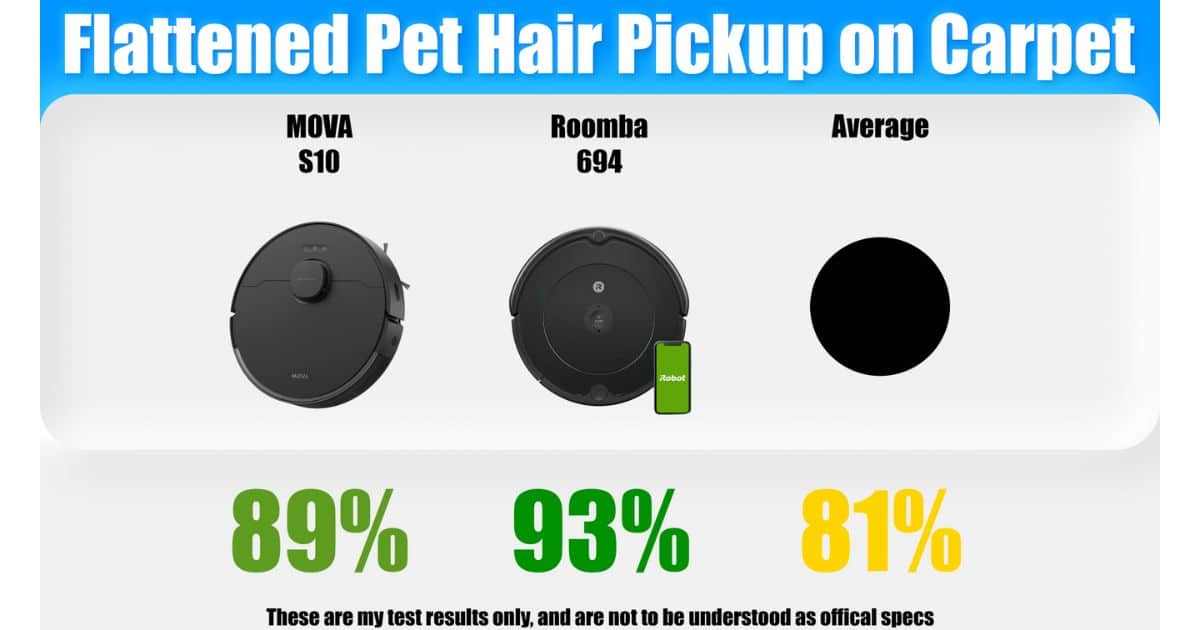
Flattened pet hair pickup graphic for carpet, listing MOVA S10 at 89% debris removed, Roomba 694 at 93%, and the average robot at 81%.
The older Roomba design slightly outperformed the S10 for this specific pet hair scenario. © Vacuum Wars

In our carpet deep clean evaluation, the S10 outperformed the Roomba. It scored 90% versus 86%, and the category average sits at 77%. So, both robots do well with sweeping and deep cleaning, but the MOVA S10 still performs more like a much more expensive robot vacuum.
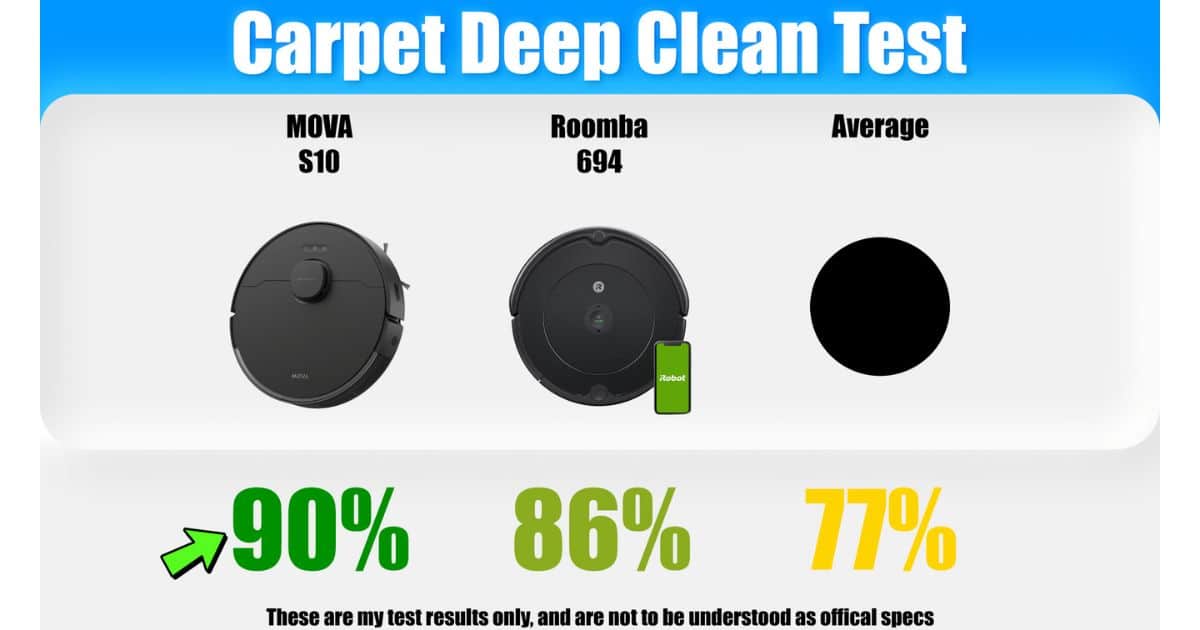
Carpet deep clean test results comparing MOVA S10, Roomba 694, and the average, with the S10 at 90% pickup, the Roomba 694 at 86%, and the average robot at 77%.
Both robots delivered strong deep cleaning scores, with the S10 holding a small advantage. © Vacuum Wars

Battery Life and Navigation Efficiency

With battery life, the MOVA S10 easily outperformed the Roomba 600 series. The S10 ran for 260 minutes on low power compared to just 60 minutes for the Roomba and well above the 162-minute average.
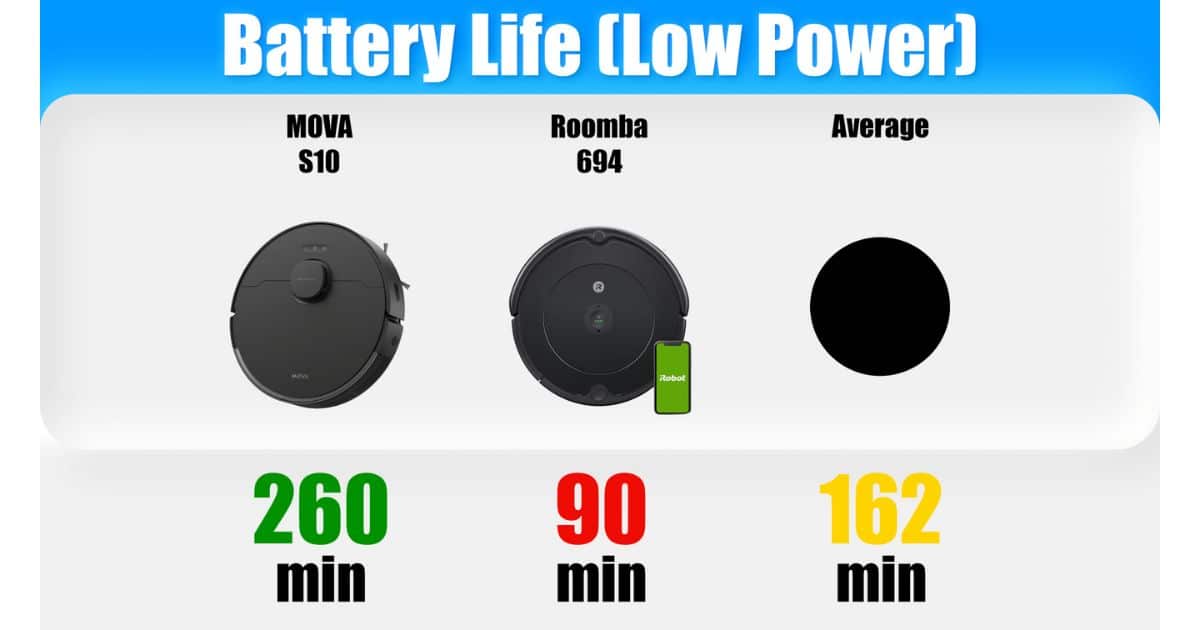
Battery life comparison for low power mode showing the MOVA S10 with a runtime of 260 minutes, the Roomba 694 at 90 minutes, and an average runtime of 162 minutes.
The S10 cleans nearly three times as long as the Roomber. © Vacuum Wars

As for navigation efficiency, the S10 covered 0.73 m² per minute, compared to 0.42 m² per minute for the Roomba. The S10 was nearly identical to the 0.72 m²-per-minute average.
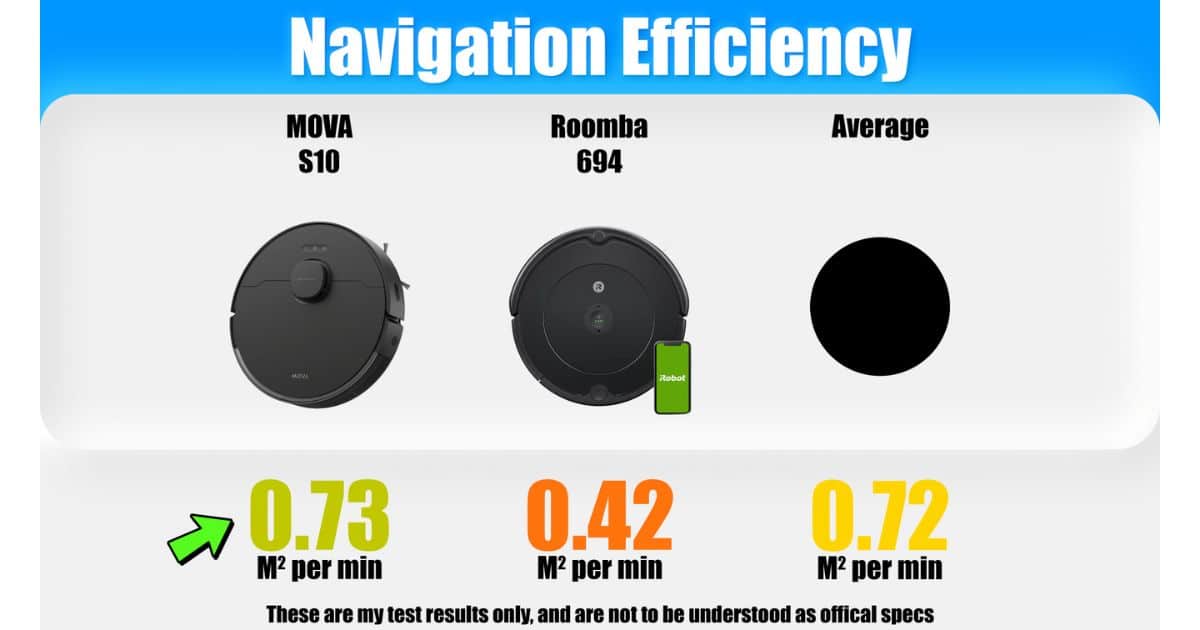
Navigation efficiency chart comparing how much floor each robot covers per minute, with the MOVA S10 at 0.73 m² per minute, Roomba 694 at 0.42 m² per minute, and the test average at 0.72 m² per minute.
Both will eventually finish a room, but the S10’s LiDAR system cleaned the space more efficiently than the Roomba. © Vacuum Wars

Reliability and Quality Control

Our only concern with many budget robot vacuums is quality control. Do the robot vacuums hold up over time, or do issues appear shortly after purchase?

We monitor this by watching Amazon one-star review percentages, which are often a reliable signal. The S10 has been performing well in this area.

Final Thoughts: MOVA S10 Review

As for the Vacuum Wars Top 20 rankings (updated weekly), neither model makes the list. The S10 is by far the highest-ranking robot vacuum mop combo in its price range; however, it sits at around 51st overall. The Roomba 694 (the top model in the 600 series) ranks 110th. So there’s a big performance gap in favor of the MOVA S10.

The bottom line is that budget robot vacuums have changed dramatically. If you haven’t shopped for one since the early days when they bounced around randomly and didn’t mop, you should consider the MOVA S10. It’s a great entry point into the modern robot vacuum world without overspending.
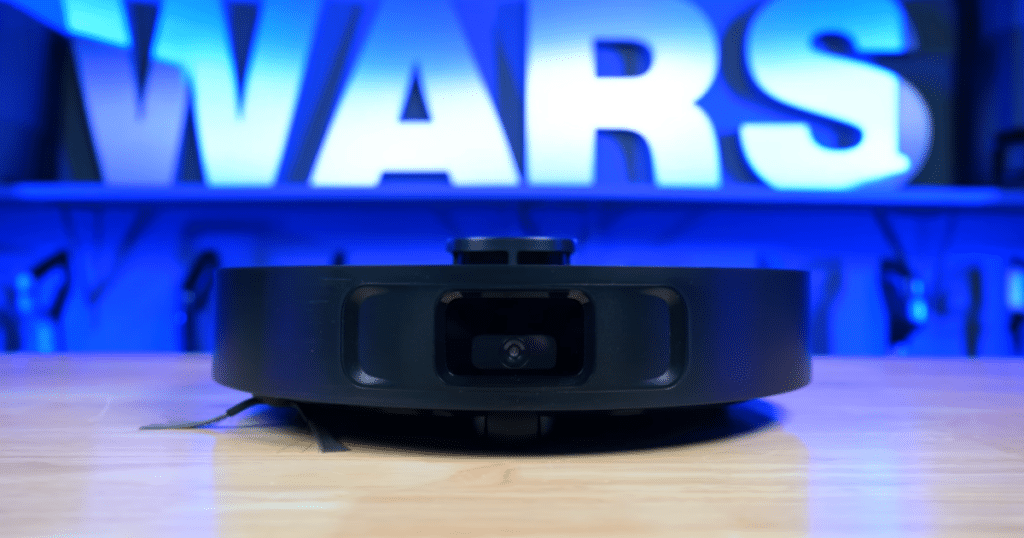
MOVA S10 robot vacuum and mop featuring a front-mounted camera, photographed in the Vacuum Wars studio.
The MOVA S10 represents an accessible entry point into modern robot vacuum and mopping technology without a premium price. © Vacuum Wars

Who the MOVA S10 is For / Who Should Skip

Who it’s for:

  • Budget shoppers who want modern navigation, including LiDAR mapping and app-based controls like virtual barriers that aren’t available on the Roomba 600 series.
  • Homes with mixed flooring, since the MOVA S10 can vacuum and mop in the same run and lift its mop pad when it detects carpet.
  • Pet owners concerned about hair tangles, as the S10’s rubber main brush performed far better than older bristle-style rollers.

Who should skip:

  • Anyone who prioritizes obstacle avoidance, as the S10’s avoidance performance was well below average in our testing.
  • Shoppers who want hands free mop maintenance will want more advanced mop washing and drying and water maintenance features found in higher tier models.


Compare MOVA S10 vs Roomba 694

Vacuum Wars independently buys and tests every vacuum and floorcare product we review—providing unbiased, data-driven insights so you can make informed buying decisions and find the right technology for your home. Read more about how we test robot vacuums.

More Robot Vacuum Reviews

  • Best Robot Vacuum $1300 to $1600 – January 2026

    Looking for the best robot vacuum between $1300 and $1600? We buy every robot vacuum we test, so our rankings reflect real performance data. After evaluating 150+ models, we found standout robots in this range that deliver flagship-level cleaning without the ultra-premium price.

  • MOVA S10 Robot Vacuum Review — Budget LiDAR Robot Vacuum With Mopping

    The MOVA S10 is one of the most capable budget robot vacuums we’ve tested, offering lidar navigation, mopping, strong suction, and standout battery life. Here’s how it performed in all our Vacuum Wars tests and how it compares to the Roomba 600 series.

  • Dreame Matrix10 Ultra Robot Vacuum Review: Hands-On Testing vs Dreame L50 Ultra

    The Dreame Matrix10 Ultra is Dreame’s latest and most innovative robot vacuum and mop combo, featuring a unique mop-switching system not found on any other model. We purchased one and tested it over several weeks to see how it performs in real-world use. In this Dreame Matrix10 Ultra review, we break down its pros and…

  • Matic Robot Vacuum Review: A New Approach to Robot Vacuum and Mop Design

    A fresh look at the innovative Matic robot vacuum, built from the ground up with a unique design that delivers impressive performance but also introduces some notable trade-offs. This review breaks down its strengths and weaknesses after extensive hands-on testing.

  • Top Robot Vacuums for Any Budget (Late 2025) — Our Picks by Price Range

    Robot vacuums can range from $150 to $2,500, with dramatically different features at each tier. In our Best Robot Vacuum for Any Budget – Late 2025 guide, we break down the winners by price range to help every shopper find the right fit—whether you need an affordable starter model or a top-tier robot vacuum mop…

  • Best Robot Vacuum Above $1600 – January 2026

    Explore Vacuum Wars’ top picks for robot vacuums above $1,600 — the frontier of home cleaning innovation. From robotic arms to multi-mop switching docks, these flagship models showcase the most advanced automation and smart features available today, all backed by Vacuum Wars’ independent testing and real performance data.

  • Best Robot Vacuum $1000 to $1300 – January 2026

    We buy and test every robot vacuum ourselves, and our $1000–$1300 pick is based on real data, not marketing claims. We look for premium performance as well as features like strong suction, advanced navigation, and self-empty docks without the ultra-premium price.

  • MOVA Z60 Ultra Roller Complete Robot Vacuum Review: Can It Outperform the Dreame Aqua10?

    We tested the MOVA Z60 Ultra Roller Complete, Dreame’s latest sub-brand flagship robot vacuum and mop combo, to see how it stacks up against the Dreame Aqua 10 Roller. Both impressed, but the Z60’s superior mopping performance and hair management helped it come out on top in our tests.

More Reviews

Home Robot Vacuum Reviews MOVA S10 Robot Vacuum Review — Budget LiDAR Robot Vacuum With Mopping

Christopher White
author avatar
Christopher White CEO
Christopher White is the CEO of Vacuum Wars, the premier YouTube channel dedicated to vacuum cleaner reviews. Over the past eight years, Vacuum Wars has become a trusted resource, meticulously reviewing hundreds of robot vacuums, cordless vacuums, carpet cleaners, and various floor care products. Known for their comprehensive in-house testing, Vacuum Wars has built one of the most extensive databases of vacuum cleaner metrics available. Under Christopher’s leadership, the channel has maintained a strict no-sponsorship policy, ensuring that all reviews remain unbiased and trustworthy. This dedication to integrity has garnered a loyal following of over 300,000 subscribers who rely on their expert advice. Christopher is also a recognized authority on robot vacuums, boasting one of the largest private collections of these devices worldwide. Learn more

Our Top Picks

Current Vacuum Wars product rankings:

Best Cordless Vacuums
Best Robot Vacuums
Best Upright Vacuums
Best Carpet Cleaners
Best Air Purifiers
Best Spot Cleaners