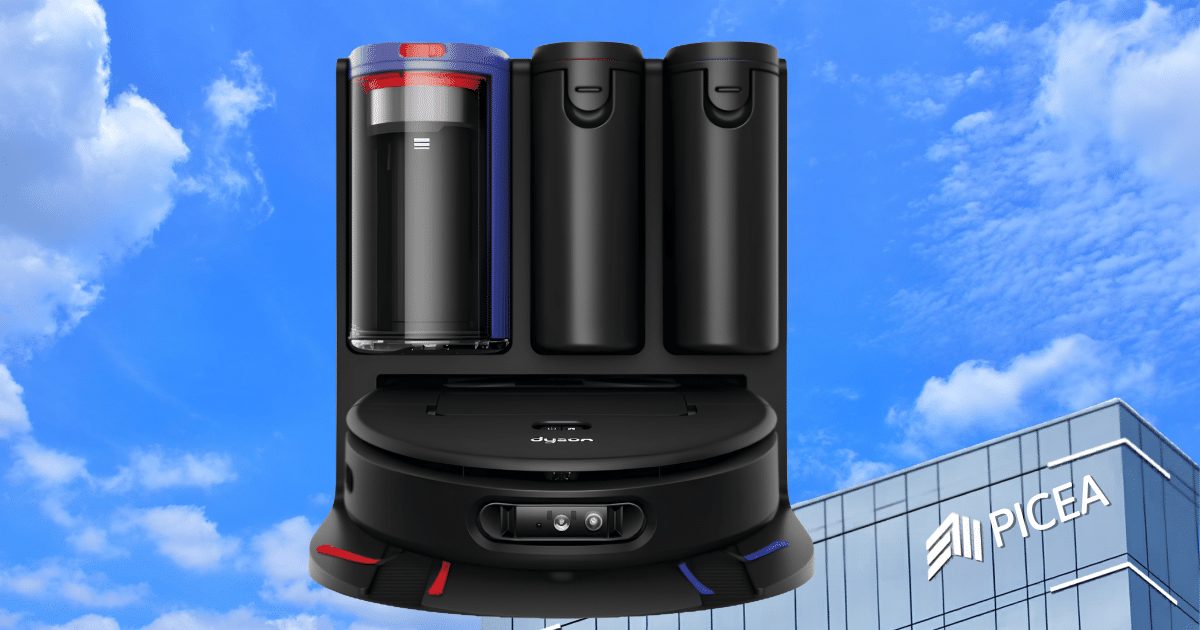
Dyson has confirmed that its latest robot vacuum, the $1,200 Spot+Scrub AI, uses a third-party motor and lidar-based navigation system—a notable departure from the company’s long-standing reliance on its proprietary motor technology.
In an interview with The Verge, Dyson said the new model was “co-engineered,” combining in-house design elements with external platforms. The company cited speed and cost as key factors in the decision, signaling a shift toward faster development in the increasingly competitive robot vacuum and mop category.
For a brand built around its high-speed digital motors, the move marks a significant change in strategy—particularly as the Spot+Scrub AI introduces several firsts for Dyson, including a mop system, obstacle avoidance, and a multifunction auto-empty dock.
A Shift in Technology—and Priorities
The Spot+Scrub AI represents a broader evolution in Dyson’s robot vacuum lineup. Previous models, such as the 360 Vis Nav, relied heavily on proprietary engineering, including Dyson’s own motor systems and camera-based navigation.
With the new model, Dyson has adopted lidar navigation and an external motor platform, aligning it more closely with common architectures seen across the industry. While outsourcing key components is not unusual in this category, it is a notable pivot for Dyson given its historical emphasis on in-house innovation.
What We Found in Testing
In an independent review at Vacuum Wars, the Spot+Scrub AI delivered a mix of standout features and more average performance results—some of which may reflect this shift in design priorities.
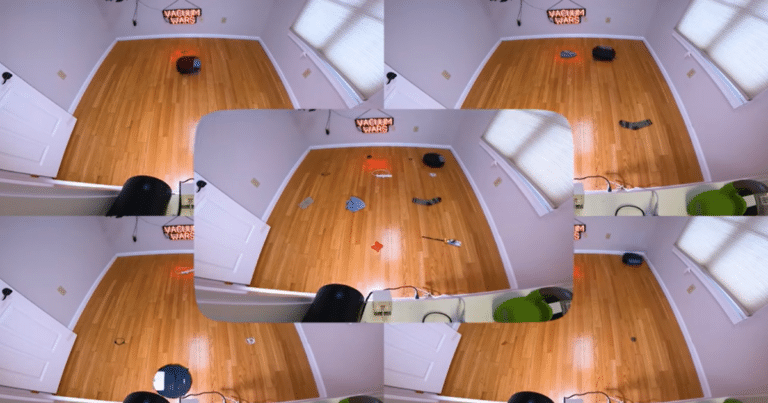
One of the most notable strengths was its obstacle avoidance system. The robot avoided 20 out of 24 objects in standardized testing, significantly above the category average of 15, placing it in top-tier territory for this feature.
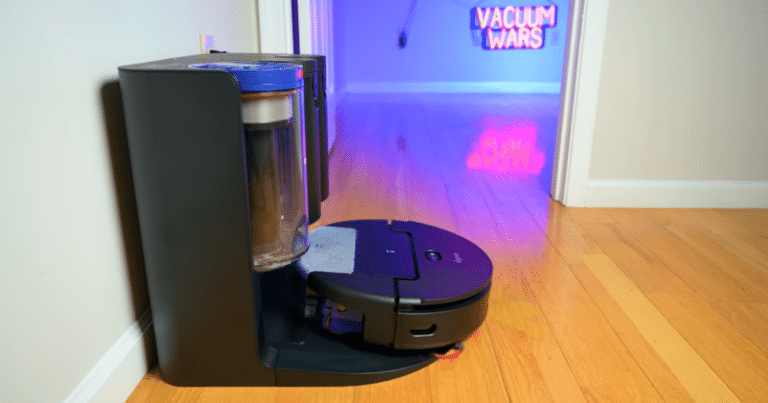
Dyson’s new bagless auto-empty dock also performed well in real-world use, particularly with pet hair. After nearly two weeks of operation in a multi-pet environment, the system effectively separated and removed debris while remaining dry—an area where bagless systems have historically struggled.
The addition of a roller-style mop produced balanced results. It scored 101 in dried stain removal testing (above the 94 average), with an overall mopping performance roughly in line with category norms.
Performance Tradeoffs Emerge
At the same time, some core vacuuming metrics came in closer to average—and in some cases slightly below.
In carpet deep-clean testing, the Spot+Scrub AI removed 76% of embedded debris, just under the 78% category average. Pet hair pickup was similarly average at 81% versus an 82% benchmark.
Navigation efficiency was another area of concern. Despite switching to lidar, the robot covered space at a rate of 0.57 square meters per minute, below the 0.71 average, which can result in longer cleaning cycles over time.
Battery performance showed meaningful improvement over Dyson’s previous robot, but still fell short of category leaders, with an estimated 846 square feet per charge compared to a 1,170 average.
How Vacuum Wars Tests Robot Vacuums: Step into the world of Vacuum Wars, where real-world tests, straight-forward reviews, and no sponsored products redefine robot vacuum evaluations.
A More Competitive—but Different—Dyson
Taken together, the results suggest that Dyson’s shift to third-party components may be part of a broader effort to accelerate feature development and close gaps in areas where its previous robots lagged—such as mopping, automation, and obstacle avoidance.
That strategy appears to be working in some respects. The Spot+Scrub AI is the first Dyson robot to offer a full-featured, all-in-one system, and in testing it delivered strong results in several key categories.
However, the tradeoff is a performance profile that is less differentiated in certain vacuuming metrics—an area where Dyson has historically stood out.
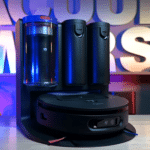
Dyson Spot+Scrub Ai
Vacuum Wars Stars 3.49
The Dyson Spot+Scrub Ai is a premium robot vacuum-mop combo that introduces several firsts for Dyson, including a bagless auto-empty dock, AI obstacle avoidance, and a roller mop system, and overall it performs well with some tradeoffs. Its standout feature is the cyclonic bagless dock, which effectively separated heavy pet hair after nearly two weeks without cleaning and stayed completely dry, while the AI system avoided 20 of 24 objects versus a 15 average, making it top-tier for a first attempt. The roller mop scored 101 on coffee stain removal (above the 94 average) with a combined mopping score of 20.1, though it left 1.3g of water (slightly above average). Battery efficiency improved significantly to 1.38 minutes per percent, covering about 846 sq ft per charge, still below the 1,170 average. Vacuuming was solid but slightly weaker than its predecessor, with 76% carpet deep clean pickup (vs. 78 average) and 81% pet hair pickup (vs. 82 average), though crevice performance was excellent at 3.5 vs. 2.0. Downsides include slow navigation (0.57 vs. 0.71 average), poor anti-tangle (31% hair wrap), limited 20mm obstacle climbing, a basic app, and a large 4.3-inch height that can hinder maneuverability. See additional info
Bottom Line
Dyson’s confirmation—shared via The Verge interview—that it is using third-party motor and navigation technology marks a clear shift in approach. Rather than relying solely on proprietary engineering, the company appears to be prioritizing speed to market and feature parity in a rapidly evolving category.
Based on testing, that shift has resulted in a more competitive overall product that has a different balance of strengths and weaknesses than previous Dyson models.
See also: Who is Shenzhen Picea Robotics?
Top 20 Robot Vacuums
Explore Vacuum Wars’ always up-to-date rankings of the best robot vacuums, based on independent, hands-on testing. We purchase every unit ourselves and have evaluated more than 150 models, giving us a deep benchmark for cleaning performance, navigation, battery life, and advanced features like obstacle avoidance and mopping.