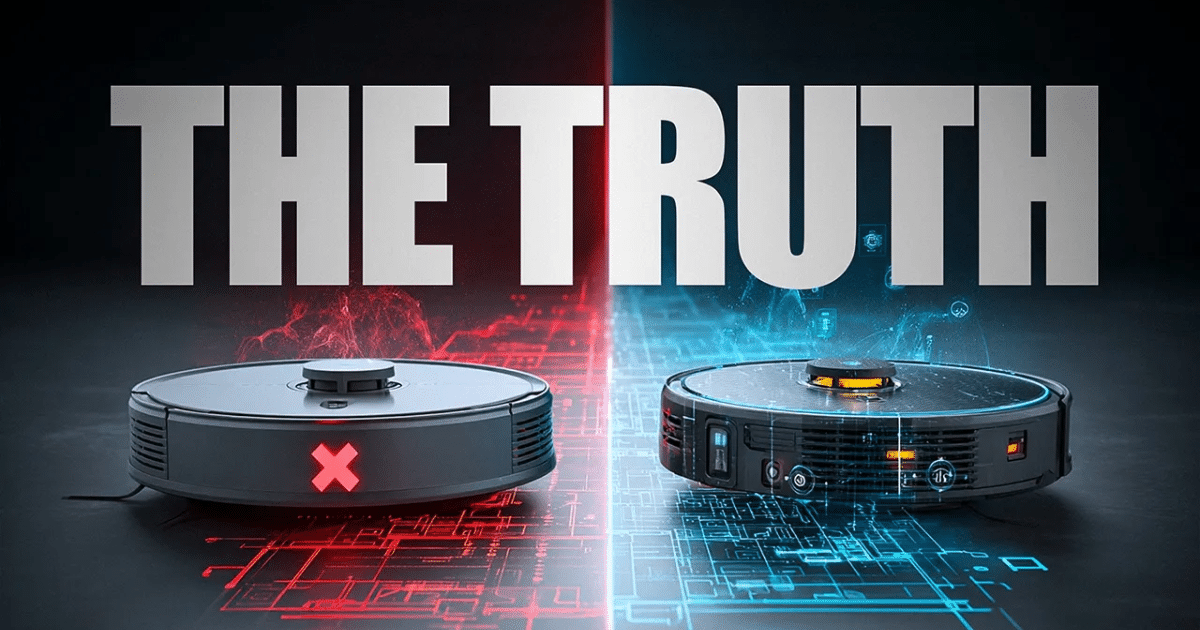
Robot vacuums have come a long way from simple bump-and-turn machines. Today, the best AI robot vacuums use layered technologies that work together to clean your home with surprisingly little input from you. But what does “AI” actually mean in a robot vacuum — and why does it matter? In this article, we break down every level of the robot vacuum autonomy stack: the layers of technology that combine to make a robot vacuum smarter, more capable, and more autonomous.
AI Robot Vacuum Key Takeaways
AI robot vacuums use layered technologies to sense, map, navigate, and clean autonomously. This is commonly referred to as the Autonomy Stack.
- Level 1: Object recognition: Advanced models identify objects using CNNs, cameras, LiDAR, and structured light sensors.
- Level 2: Semantic mapping: AI allows robots to understand room context instead of just recognizing shapes.
- Level 3: Adaptive cleaning: AI systems can automatically adjust cleaning behavior based on floors, pets, obstacles, and dirt levels.
- Level 4: Agentic AI: Emerging VLM and LLM technologies may enable more autonomous, multi-step cleaning behavior.
How Robot Vacuums Worked Before AI
First, let’s start off by talking about how a robot vacuum works without the help of AI.
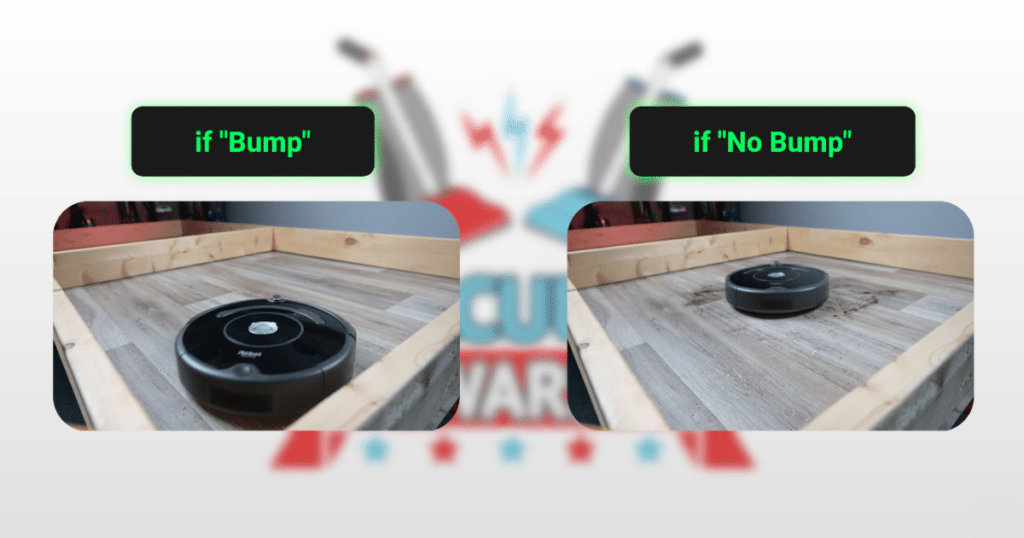
A non-AI robot uses “if/then” scripts to trigger robotic responses based on sensor input. This functions kind of like a light switch: If “Bump,” then turn. If “No Bump”, then drive straight. Cliff sensors make the robot turn away from staircases, carpet sensors make it increase suction, and bump sensors make the robot turn. These behaviors can be pretty sophisticated, like iRobot‘s Dirt Detect acoustic sensors, which pick up vibrations from heavy debris to trigger extra cleaning.
These scripts are all hard-coded, which means they are written into the software and won’t change unless the software is rewritten. This is the way robot vacuums worked for a long time, and many economy models still use a lot of these technologies today.
Understanding the Robot Vacuum “Autonomy Stack”
Now let’s see how the introduction of AI changes things. One useful way to understand AI in robot vacuums is through what can be called the “autonomy stack.” This refers to the layers of technologies that work together to allow a robot vacuum to sense, map, clean, and interact with users.
The autonomy stack can generally be broken into four layers:
- perception,
- mapping,
- action,
- and interaction.
Each layer adds another level of intelligence and automation.
Level 1: Perception — How AI Robot Vacuums Identify Objects
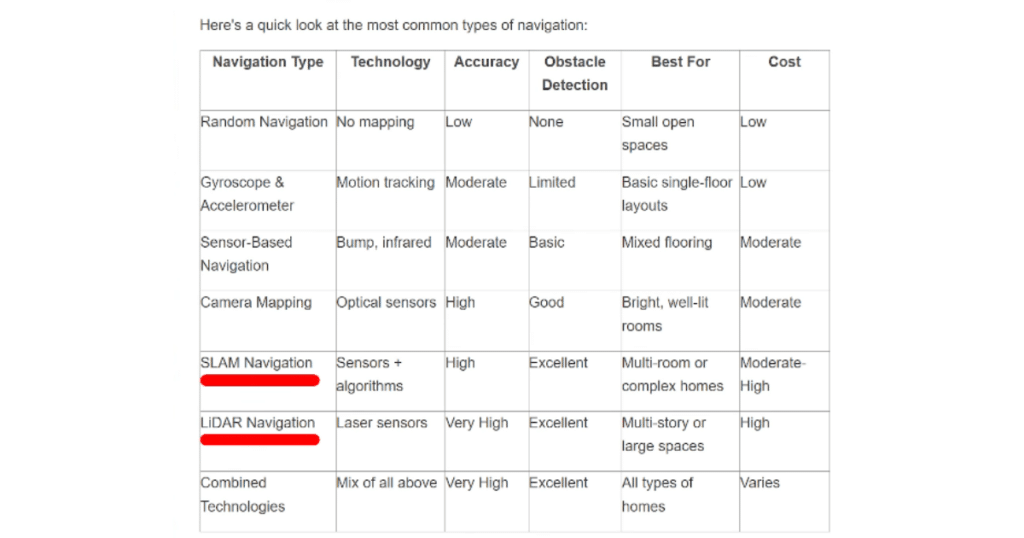
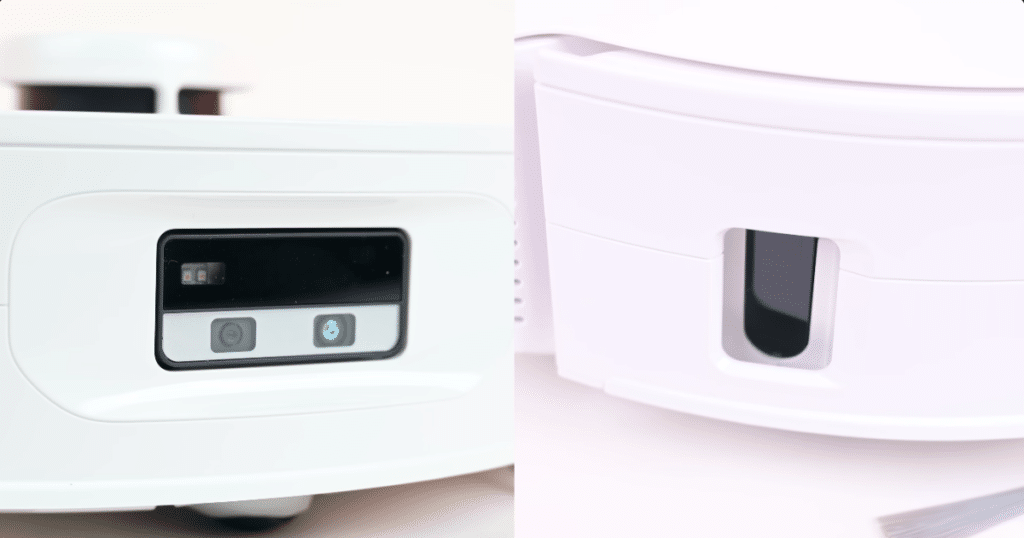
Level one starts at the sensors, and we’ll call this the “Perception” layer. Modern robot vacuums have all kinds of sensors on them. Some are designed for sensing larger environments, such as LiDAR navigation systems or VSLAM camera navigation. These systems detect larger or longer-ranged objects like the walls of a room. Other sensors, like 3D structured light systems or cameras, are designed for detecting much smaller objects for obstacle avoidance.
A robot with pre-scripted responses will behave automatically to sensor input. A robot with AI, however, is able to actually interpret the sensor data using Convolutional Neural Networks, or CNNs.
These neural networks are extremely complex, but they generally have three main parts:
- First is the robot’s training data, called “weights,” which are expressed as grids of numbers.
- Then there’s the flash memory, which stores the robot’s training library.
- Finally, there’s the NPU, or Neural Processing Unit, which is the physical chip where the robot processes and interprets sensor inputs using its training data.
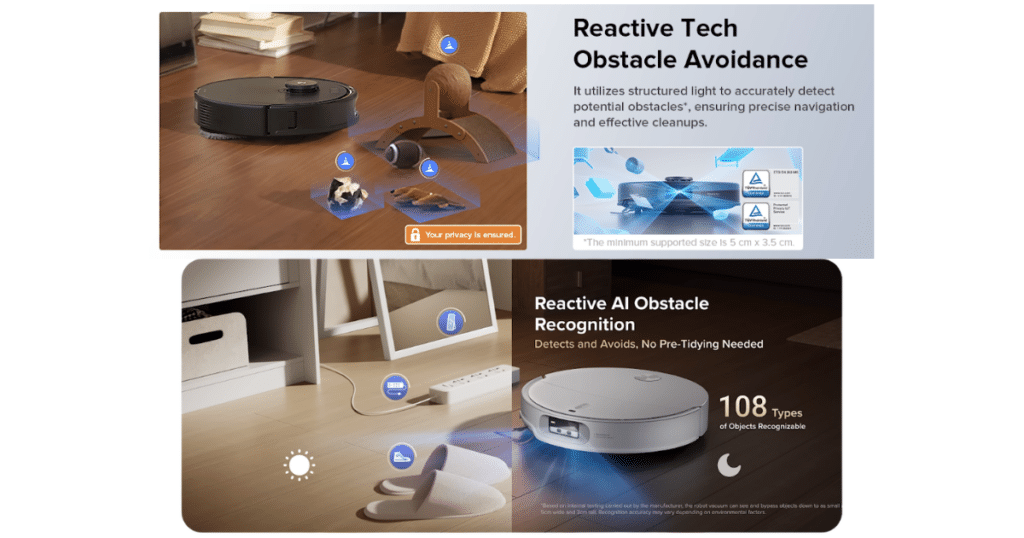
You can compare a robot that uses a CNN with one that doesn’t by looking at systems like Roborock’s Reactive Tech obstacle avoidance versus ReactiveAI. If the Reactive Tech system (without CNN) detects an obstacle, it doesn’t know what the object actually is, so it reacts with a coded response. If the ReactiveAI system (with CNN) detects an obstacle, it attempts to identify it, triggering different reactions depending on whether the object appears to be a sock, a shoe, or even a pet.
Because processing all of a robot’s training data in full form would require too much computing power, the information is heavily simplified for robot vacuums so that the onboard processing remains lightweight and efficient.
See also: How Vacuum Wars Tests Obstacle Avoidance
Visual Language Models May Be the Future of Robot Vacuum AI
The next step in robot vacuum AI is beginning to appear in the form of VLMs, or Visual Language Models.
We are especially curious to see this technology in action on robots like the Narwal Flow 2. Not only will the Flow 2 be able to use its local CNN system to identify objects, but it may also be able to access a cloud-server-based VLM to help identify objects that fall outside of the robot’s local training data. This could create a virtually limitless ability to recognize unfamiliar items.
Level one in the robot stack is impressive, but at this stage the robot is still only recognizing objects. To understand where those objects fit into the bigger picture of a home, we move to Level 2: the Mapping layer.
Level 2: Mapping — How AI Robot Vacuums Understand Your Home
Level 2 AI is responsible for mapping and navigation, where all of the information gathered by the sensors becomes meaningful knowledge for the robot. This is the layer where the robot reads its environment, determines where it is on the map, and decides where to go next.
Non-AI robot vacuums are also capable of creating maps and figuring out where they are located, but they typically do this only by logging large geometric shapes that do not carry any real meaning. A robot vacuum with AI, however, can begin to understand contextual information about its environment that a non-AI robot cannot. This is called semantic mapping, which means the robot can establish context on its own and reason about what it sees. An AI-equipped robot might recognize a bed and infer that it is in a bedroom, or recognize a dining table and infer that it is in a dining room.
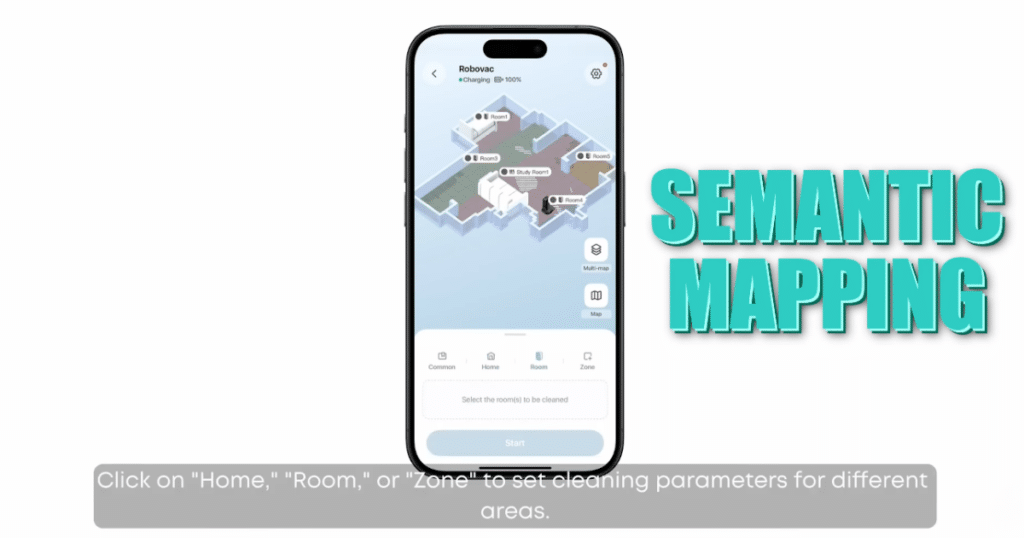
These systems are not perfect yet, but they improve with each generation of robot vacuums. And once a robot has a semantic understanding of the world around it, it can begin adjusting its cleaning behaviors to match the environment, which brings us to level three.
Level 3: Action — How AI Controls Robot Vacuum Behavior
Level three is the Action layer, where all of the robot’s sensing and reasoning turn into physical responses.
In a non-AI robot, a behavior is either turned on or off based on which switch has been triggered. Maybe it increases suction when it detects carpet, or maybe it turns around after hitting a wall, but the number of available behaviors is relatively limited.
With AI, the robot’s responses become far more flexible, and in many cases the hardware itself evolves as well. If the robot’s sensors recognize a pet walking nearby, the Action layer may cause the robot to pause, turn away slightly, or even reduce suction in order to avoid startling the pet, depending on the model. Or perhaps the robot’s mapping system recognizes that a room is carpeted. The Action layer is what allows the robot to physically lift its mopping pads so they don’t wet the carpet, or even leave the mop pads behind at the dock like some Dreame robot vacuums are capable of doing.
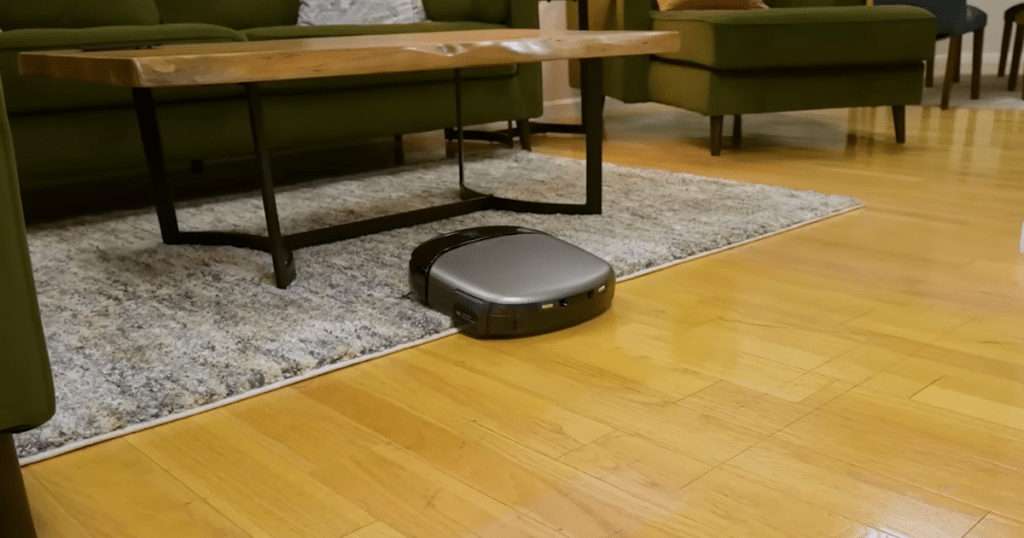
Many AI-powered robot vacuums are also equipped with proprietary AI cleaning modes, such as CleanGenius on Dreame models or SmartPlan on Roborock models. These systems attempt to clean based on what the robot believes is best for the home environment. A kitchen or bathroom may receive additional mopping passes because those areas are more likely to contain spills, while high-traffic rugs may receive multiple vacuuming passes because they likely contain more dirt. These kinds of cleaning routines could technically be programmed manually into some robot vacuum apps, but they cannot happen automatically without AI.
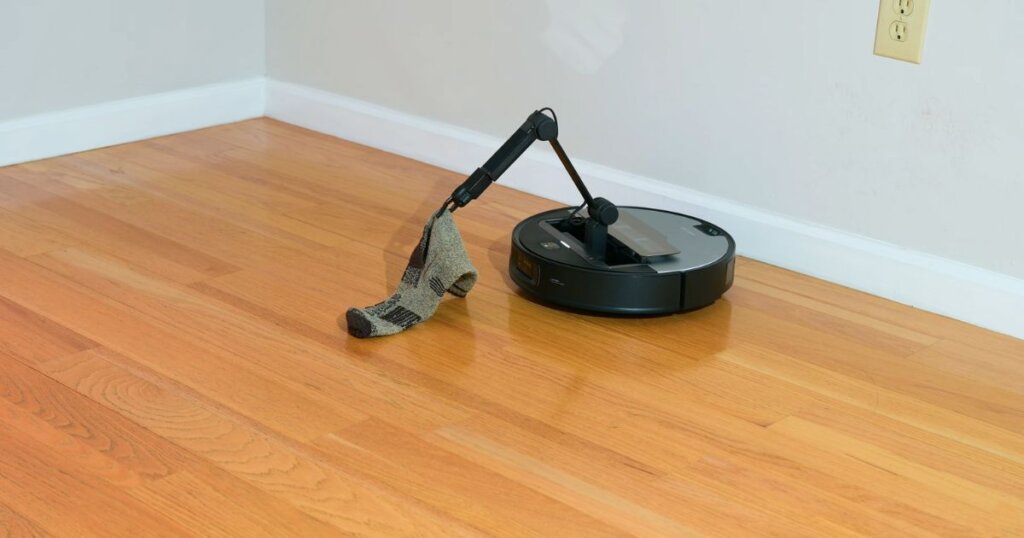
And some of the future possibilities being unlocked by this technology are especially interesting. Robots with robotic arms, like the Roborock Saros Z70, as well as stair-climbing robot vacuum systems currently in development, would not be possible without AI.
Level 4: Interaction — Natural Language Control for Robot Vacuums
The final layer of the robot vacuum autonomy stack is the Interaction layer. Because of the way many of us encounter AI in our daily lives, this is probably the layer most people think about when they hear a robot vacuum has “AI.” This layer focuses on Natural Language Processing, or NLP, which is how computers understand human speech. If you have ever answered “Yes” or “No” to an automated phone menu, then you have already interacted with NLP.
Most robot vacuums today can integrate with third-party smart home voice assistants, while some premium models also include built-in voice assistants. These systems respond to spoken commands for convenience, but they usually require commands to be phrased very precisely or the robot may fail to understand them. However, companies like Samsung are beginning to market major advancements in this area through new smart home AI ecosystems, and we are also seeing real progress in onboard voice agents like Ecovacs‘ YikoGPT.
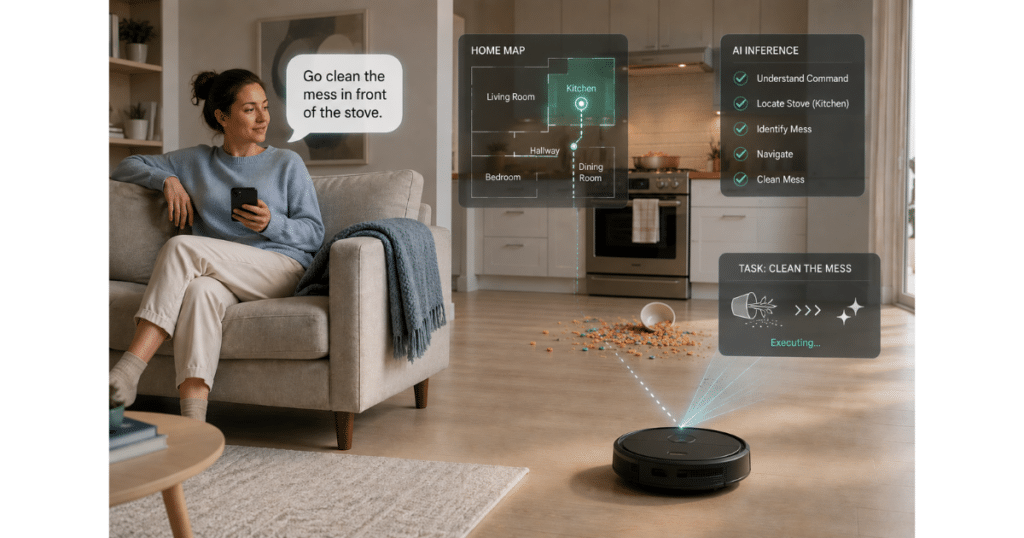
These systems can access Large Language Models, or LLMs, similar to the ones used in modern AI chatbots. This allows the robot to make inferences and identify patterns in order to better understand what the user wants. The goal is that one day you could say something like, “Go clean the mess in front of the stove,” and the robot would infer that the stove is in the kitchen by referencing its map of the home. The robot could then navigate to the kitchen, identify the mess, and clean it appropriately, combining every layer of the autonomy stack into one seamless action.
The Future: Agentic Robot Vacuums and AI Home Assistants
There are already signs that the future of robot vacuums may involve more agentic AI systems that require less programming inside of smartphone apps and can handle more complex, multi-step cleaning tasks automatically.
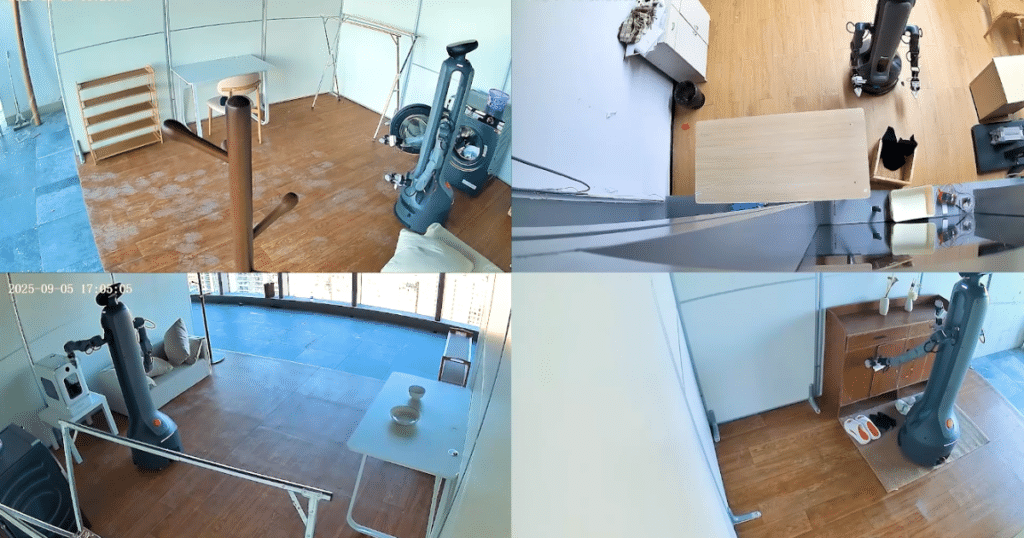
Some brands, including SwitchBot, are beginning to envision AI home robots as broader household assistants, both with and without vacuum bases. As these systems continue evolving, robot vacuums are gradually becoming less like simple automated appliances and more like fully autonomous home robots.
Of course, these new technologies also come with important conversations around privacy and security, especially as onboard cameras, cloud processing, and advanced AI integrations become more common. That is a topic we will likely explore in greater detail in the future.
For now, what is clear is that AI is rapidly reshaping the robot vacuum industry. From smarter obstacle avoidance and semantic mapping to adaptive cleaning strategies and conversational voice assistants, AI is fundamentally changing how robot vacuums understand and interact with the home environment.
And based on what we are already seeing from companies like Roborock, Narwal, Samsung, Ecovacs, Dreame, and SwitchBot, the next generation of robot vacuums may look very different from the robots we know today.
Bottom Line: What to Look for in an AI Robot Vacuum
The term “AI” covers a lot of ground in the robot vacuum space — from basic obstacle avoidance all the way to natural language understanding. When shopping for the best robot vacuum with AI, it’s worth knowing which layers of the autonomy stack a robot actually supports:
- Perception AI — Can it identify specific objects, or just detect that something is there?
- Semantic mapping — Does it understand room context, or just log shapes?
- Adaptive cleaning behavior — Does it adjust its cleaning strategy automatically based on what it knows?
- Natural language control — Can you give it flexible commands, or does it require precise phrasing?
The more layers a robot covers — and the more sophisticated each layer is — the more autonomously it can clean your home with less work from you.
Top 20 Robot Vacuums
Explore Vacuum Wars’ always up-to-date rankings of the best robot vacuums, based on independent, hands-on testing. We purchase every unit ourselves and have evaluated more than 150 models, giving us a deep benchmark for cleaning performance, navigation, battery life, and advanced features like obstacle avoidance and mopping.
FAQs About AI Robot Vacuums and Agentic AI
What is an AI robot vacuum and how is it different from a regular robot vacuum?
An AI robot vacuum uses technologies like computer vision, semantic mapping, neural networks, and adaptive cleaning systems to interpret its environment and make decisions automatically. Traditional robot vacuums mainly rely on pre-programmed “if/then” responses, while AI robot vacuums can identify objects, understand room context, and adjust cleaning behavior dynamically.
What is the robot vacuum autonomy stack?
The robot vacuum autonomy stack refers to the layered technologies that allow a robot vacuum to operate autonomously. These layers typically include perception, mapping, action, and interaction. Together, they enable modern AI robot vacuums to identify objects, understand room layouts, make cleaning decisions, and respond to natural language commands.
What is Agentic AI in robot vacuums?
Agentic AI refers to AI systems that can independently plan and complete multi-step tasks with less manual programming from the user. In robot vacuums, this could mean understanding a spoken command like “clean the mess in front of the stove,” identifying where the kitchen is located, navigating there, detecting the mess, and choosing the correct cleaning method automatically.
How do AI robot vacuums recognize objects like cords, socks, and pet waste?
Many advanced robot vacuums use Convolutional Neural Networks, or CNNs, combined with cameras and structured light sensors to recognize objects. Instead of simply detecting that an obstacle exists, AI robot vacuums attempt to classify what the object actually is so they can react differently depending on whether they see a cable, a shoe, a sock, or a pet.
What are Visual Language Models (VLMs) in robot vacuums?
Visual Language Models, or VLMs, are an emerging AI technology that may allow robot vacuums to combine onboard object recognition with cloud-based AI systems. This could greatly expand a robot vacuum’s ability to recognize unfamiliar objects beyond its local training data. Upcoming models like the Narwal Flow 2 are expected to showcase early examples of this technology.
Will future AI robot vacuums work more like home assistants?
Many manufacturers appear to be moving in that direction. Companies like Samsung, Ecovacs, SwitchBot, Roborock, and Narwal are developing AI systems that combine smart mapping, natural language processing, adaptive cleaning, and advanced automation. The long-term goal is for AI robot vacuums to function more like autonomous home assistants that require less manual app programming and can handle increasingly complex tasks on their own.