We have some somber news to cover today, and frankly, it marks the end of an era for our industry. The Vacuum & Sewing Dealers Trade Association—better known to many of us as the VDTA—officially shut down in 2025.
For over forty years, this organization was the heartbeat of the independent vacuum dealer network. It was the annual gathering place where shop owners, repair technicians, and manufacturers came together to see the latest technology, shake hands, and keep the “Main Street” vacuum business alive.
But in August of 2025, the lights went out. The website was taken offline, phones were disconnected, and the association effectively ceased to exist. [Craft Industry Alliance]
In this article, we want to take a deeper look at what happened. We’re going to examine the immediate events that led to this collapse, because they are tragic in their own right. But more importantly, we need to talk about why this happened. The fall of the VDTA isn’t just about a trade show running out of money; it is a symptom of a massive, fundamental shift in how we—the consumers—buy, use, and think about vacuum cleaners.
This is the story of how the industry changed right under our feet.
The News Breakdown
First, let’s look at the facts of the shutdown.
The signs of trouble had been visible for a while. The VDTA had been attempting to rebrand and pivot to stay relevant, recently changing the name of their expo to the “Create + Clean Expo” in an effort to merge the sewing and vacuum worlds more tightly. But by February 2025, when they held their show in Las Vegas, the writing was on the wall. Attendees reported that the show floor was sparsely populated, with very few major vacuum vendors even showing up. [Craft Industry Alliance]
Then, in August 2025, the collapse became official—and unfortunately, it was messy. Reports indicate that the organization went dark without warning. Instructors and contractors who worked at the 2025 show have claimed they were never paid for their time, and that communication from ownership simply stopped. [Cheryl Sleboda]
An email from the owner earlier in the year acknowledged the show was “underwater” financially, admitting that holding the 2025 event was a gamble that didn’t pay off. [Craft Industry Alliance]
It’s a sad, somewhat chaotic end to an institution that, for decades, was the highlight of the year for thousands of small business owners.
But to blame this entirely on recent mismanagement would be missing the forest for the trees. The VDTA didn’t fail just because of one bad year. It failed because the ecosystem it served—the independent vacuum dealer—has been slowly eroded by three massive forces over the last twenty years.
The Retail Shift
The first force is the most obvious one: where we buy.
If you go back to the 1980s or 90s, and you wanted a high-quality vacuum cleaner, you really only had two options. You either let a door-to-door salesman into your living room, or you drove to a specialized vacuum store.
These stores were essentially the gatekeepers. They had exclusive deals with high-end brands like Miele, Sebo, and Riccar. You literally couldn’t buy those machines at a big-box store. This gave local dealers a geographic monopoly on quality. If you wanted the best, you had to go to them.
That monopoly, however, has since been completely dismantled.
It started with big-box stores like Walmart and Target expanding their home appliance sections, but the real final blow was the internet. Today, roughly 68% of vacuum cleaners are purchased online. [Washington Post]
We are living in a world where you can watch a review on our channel, click a link, and have a top-tier machine delivered to your door the next day. The “gatekeeper” model is gone. Even brands that were once fiercely loyal to dealers, like Miele, eventually had to adapt. By 2020, even they began authorizing sales on Amazon and through their own websites.
For the independent dealer, this meant their “moat” was filled in. They were no longer the only place to get a great machine, which meant foot traffic dwindled. And without a thriving network of dealers making money, a trade association like the VDTA simply ran out of people to serve.
The Disruption (Shark & Dyson)
The second major force was a shift in expectations, driven largely by two companies: Dyson and Shark.
For a long time, there was a stark divide in performance. The vacuums you bought at a department store were objectively worse than the ones you bought at a dealer. Dealer vacuums had better filtration, better motors, and better carpet agitation.
But around the late 2000s, that gap started to close.
Dyson had already changed the marketing game, proving consumers would pay premium prices for a vacuum off the shelf at a retail location they were already frequenting for other products. Then Shark entered the scene aggressively around 2007. They upended the industry by offering machines that—while perhaps not built to last 20 years—delivered incredible suction and features for a fraction of the price of a dealer-exclusive machine. [Washington Post]
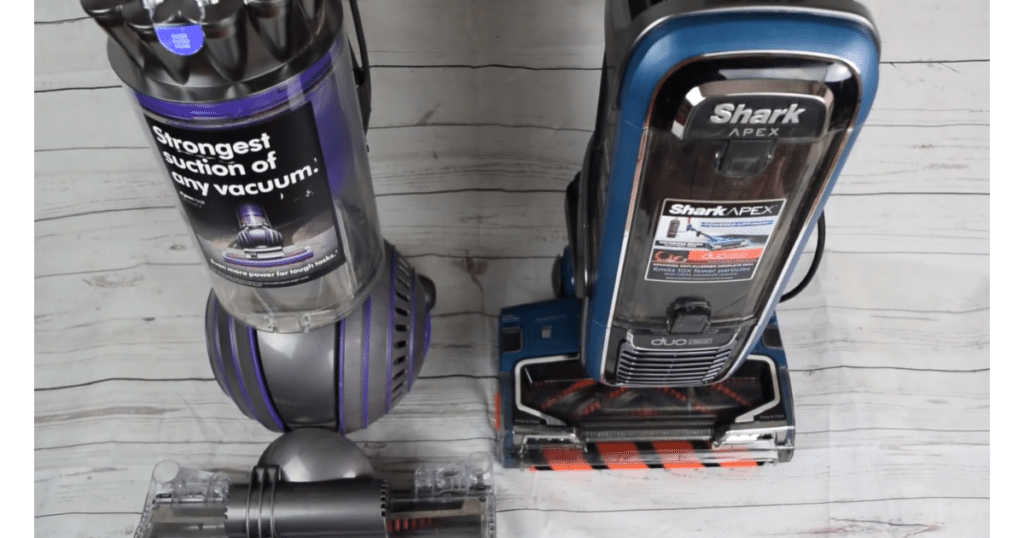
This was a disaster for the traditional industry model. Suddenly, a consumer could go to a regular store or hop on Amazon and buy a $200 or $300 vacuum that cleaned their carpets just as well as the $800 unit sitting in a dealer’s showroom.
We’ve seen the data on this channel time and time again. In many raw performance evaluations—pickup, airflow, seal—mass-market brands like Shark and Dyson often compete neck-and-neck with, or even outperform, the legacy “old guard” brands. [Vacuum Wars]
This changed the consumer mindset. We stopped thinking we needed a “specialist” to sell us a vacuum. If the machine at Target does a great job, why make a special trip to a vacuum shop?
The Tech Gap (Robots & Cordless)
The third force is perhaps the most significant because it represents where the future is going: innovation.
While the independent dealer network focused on refining the traditional bagged upright and canister vacuum—perfecting a technology that was already mature—the rest of the world moved on to entirely new categories.
We’re talking about robot vacuums and cordless stick vacuums.
These two categories have seen explosive growth over the last decade. For many households, the cordless stick vacuum has completely replaced the full-sized plug-in unit, and the global robotic vacuum market is now worth billions. [Vacuum Wars]
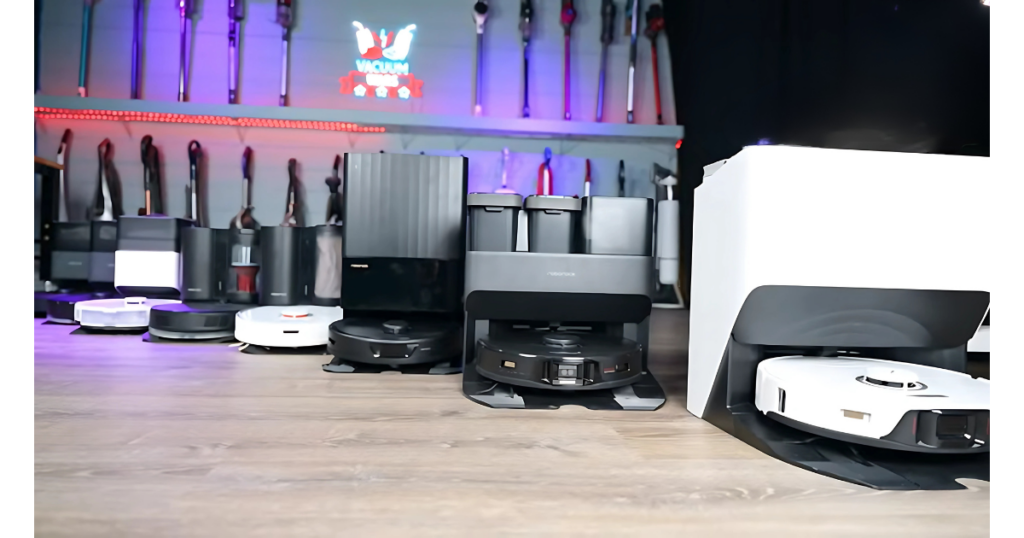
The problem for the VDTA and its members was that these innovations largely happened outside of their ecosystem.
Robots were pioneered by tech companies like Roborock and iRobot. They sold through electronics retailers and online, bypassing the vacuum repair shop entirely.
Similarly, when Dyson pushed the cordless revolution, they did it through mass retail. The legacy brands that dealers relied on—the German and American manufacturers of high-end bagged vacuums—were slow to respond.
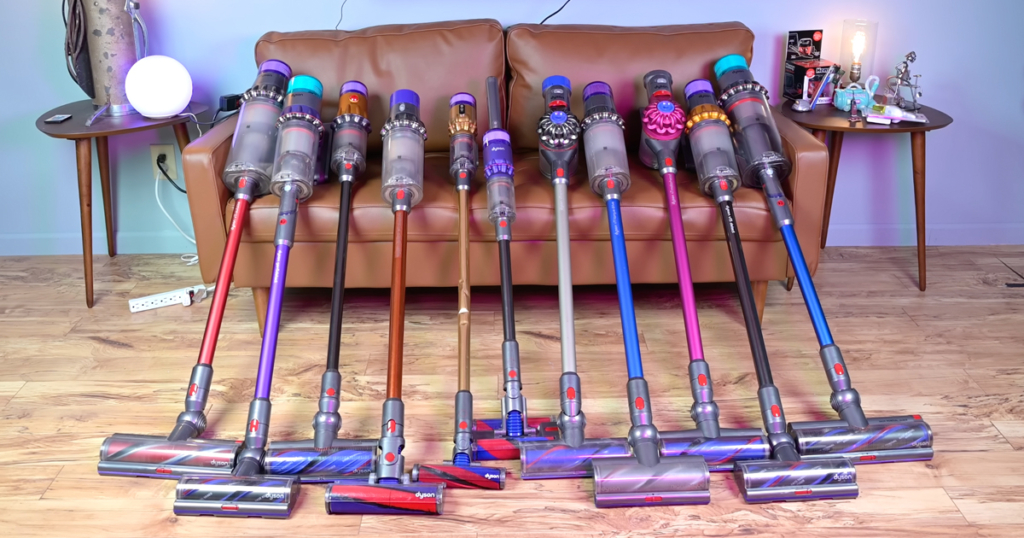
To give one example: Dyson launched its first cordless handheld vacuum, the DC16, in 2006, and its first cordless stick vacuum, the DC35, in 2011. Miele didn’t introduce a serious competitor until the Triflex in 2020 [Gear Patrol]. Sebo, a brand beloved by dealers for its quality, only unveiled a cordless stick vacuum—the Balance—in 2025.
That is nearly a 20-year head start. For two decades, if a customer walked into a vacuum shop asking for the latest cordless tech or a robot that could map their home, the dealer often had nothing to show them—or at least nothing that could compete with what was on the shelves at Costco. This innovation lag forced even loyal customers to look elsewhere.
The “Service” Dilemma
Now, we want to touch on a topic that is often debated in our community, and that is the concept of Repairability vs. Convenience.
One of the biggest losses with the fall of the independent dealer is the loss of the service center. The old model was built on a relationship: you bought a machine, and you brought it back every few years for a tune-up. You bought bags, you bought belts, and if it broke, you fixed it.
There is a very valid argument that modern, mass-market vacuums have moved away from this. We often hear from technicians that newer machines are harder to open, parts are harder to source, and the designs are less modular than the steel-and-screw machines of the past.
But—and this is important—we have to look at this from the consumer’s perspective.
It’s not just that manufacturers decided to make “throwaway” products. It’s that consumers voted with their wallets for features that inherently make repair harder, but daily life easier.
Consumers wanted lightweight machines, which meant more plastic and less metal. We wanted cordless freedom, which meant integrated batteries and circuit boards. We wanted bagless convenience, which killed the recurring revenue stream of bag sales that kept many small shops afloat.

The reality is, for the average person, we have seen that the “value” of a vacuum is no longer just about whether it will last 20 years. It’s about whether it cleans well today, whether it’s easy to grab for a five-minute mess, and whether it’s affordable.
While there is absolutely a niche of people—many of you watching our channel—who value buy-it-for-life engineering, the mass market shifted toward performance and convenience. And it appears that the dealer model was built on a version of the world where longevity was the only metric that mattered.
The Human Cost & The Future
So, where does that leave us?
I think it’s important to take a moment to acknowledge the human cost here. The shutdown of the VDTA isn’t just business stats; it’s people.
It’s the shop owners who have poured years into their communities, offering expertise that you simply cannot get from an Amazon listing. It’s the technicians who could listen to a motor and tell you exactly what was wrong with it. It’s the educators and vendors who lost money when the association folded. There is a real loss of institutional knowledge happening here.
However, we don’t believe the passion for vacuums is dead. Far from it. In fact, if you look at the engagement on our channel, or on the subreddit r/VacuumCleaners, or the various forums online, interest in floor care is higher than ever. The conversation hasn’t disappeared; it has just moved.
Instead of a trade show in Las Vegas, the “expo” is now happening every day on YouTube. Instead of asking a dealer for advice, people are asking each other in comment sections and forums. The expertise is becoming crowdsourced. And interestingly, we are seeing some independent dealers survive and thrive by adapting. They’re becoming hybrid businesses—selling online, specializing in commercial repairs, or finding niches that the big box stores can’t touch.
Conclusion
The VDTA trade show was a pillar of the 20th-century vacuum industry. Its closure is the final punctuation mark on a sentence that has been written for the last twenty years.
The world has changed. The way we clean our homes has changed.
While we can mourn the loss of the institution, we also have to recognize that the industry is evolving. The quest for the perfect vacuum isn’t over—it’s just a little more digital, a little more cordless, and a little more fast-paced than it used to be.