Home › Cordless Vacuums › Best Bissell
Independently tested. Never sponsored
Best Bissell Cordless Vacuums – 2026
The best Bissell cordless vacuums combine strong everyday cleaning with features that suit the way you use a vacuum. Across the models we have tested, we have found meaningful differences in floorheads, hair management, filtration, attachments, and comfort in handheld mode. We purchase the vacuums we evaluate and compare their cleaning results, battery performance, usability, and owner feedback to help you decide which Bissell is the best fit for your home.
Comparing more brands? See our Best Cordless Vacuums guide.
Our Bissell cordless evaluations cover carpet deep cleaning, hard-floor and carpet pickup, crevice cleaning, suction and airflow, hair tangles, battery efficiency, filtration, attachments, ergonomics, and owner feedback. We compare the exact model and package because floorheads, filters, tools, and convenience features vary across the lineup. See why you can trust our cordless vacuum reviews for more about our approach.
The ranking
The Top 3 Bissell Cordless Stick Vacuums
RankVacuumScorePrice today
Bissell PowerClean DualBrush
Vacuum Wars Stars 4.08
The Bissell PowerClean DualBrush 4196K is a cordless stick vacuum for carpets and hard floors, featuring a removable battery, three power settings, automatic suction adjustment, bright floor-head LEDs, a self-standing design, and a wall-mounted charging dock. Its dual-roller head combines a soft front roller with a standard rear brush, delivering perfect pickup scores on both surfaces for fine through extra-large debris, strong hard-floor dusting, easy carpet maneuverability, and above-average crevice cleaning. It scored 94% in the carpet deep-clean test versus a 93% cordless average, produced higher unsealed head suction than the Shark PowerDetect IP1251, and achieved average anti-tangle performance in the 14-inch hair test. Filtration was excellent, with no visible fog leakage. Runtime measured about 13 minutes on max power, while Bissell claims 50 minutes on low; battery efficiency scored 18.27 versus a 15.85 average, suggesting roughly 25–30 minutes in auto mode. Included tools are a sturdy motorized upholstery tool and combination dusting-crevice tool. Downsides include awkward handheld balance, above-average handle weight and length, a small removable 400-milliliter bin, and loud 84-decibel operation versus a 77-decibel average. It still earned a lower Top 10 ranking and offers strong overall value. See additional info
Bissell PowerClean FurFinder 4052
Vacuum Wars Stars 3.07
The Bissell PowerClean FurFinder is a cordless stick vacuum designed for pet hair removal on hard floors, area rugs, furniture, stairs, and other above-floor surfaces. Its 200-watt motor offers three power levels, while the removable lithium-ion battery delivers up to 40 minutes of runtime in low mode or 13 minutes in turbo mode. FurFinder headlights illuminate fine debris and hidden pet hair, and the tangle-free floor brush helps minimize hair wrap. The vacuum converts into handheld and high-reach configurations and includes a powered FurFinder upholstery tool for embedded hair, plus an integrated crevice tool for narrow spaces. Its HEPA sealed allergen system helps contain dust and dander inside the vacuum. Additional features include a 0.4-liter dustbin, self-standing storage, and an included wall mount. Weighing approximately 7.3 pounds, the PowerClean FurFinder combines cordless versatility with specialized tools intended for routine cleaning in homes with pets and quick cleaning between uses. See additional info
Bissell PowerClean 4173
Vacuum Wars Stars 3.02
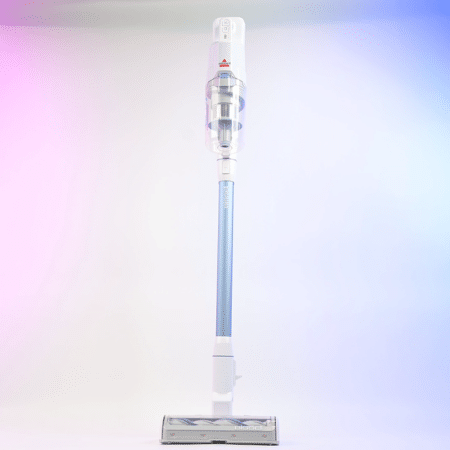
The Bissell PowerClean 4173 is a budget cordless stick vacuum that delivered strong floor-cleaning performance in Vacuum Wars’ studio evaluations. It handled debris well on hard floors and carpets and achieved a perfect 100% carpet deep-clean result, compared with the 93% cordless-vacuum average. Its sealed HEPA filtration passed the fog evaluation without visible leakage, and it operated at 74 dB on maximum power, quieter than the 77 dB category average. Other conveniences include bright floorhead LEDs, a removable battery, self-standing storage, and up to 40 minutes of runtime on low power. Tradeoffs include a heavy 1,880-gram handle, a small 400 mL dustbin, manual bin emptying, a limited attachment package, slightly below-average long-hair performance, and recurring customer reports of brush-roll, suction, and wand failures over time. See additional info
Buying guide
How We Test Bissell Cordless Vacuums
We evaluate Bissell cordless vacuums using the same standardized studio tests and scoring system we use throughout the cordless vacuum category. Our evaluations cover carpet deep cleaning, hard-floor and carpet pickup, crevice cleaning, suction and airflow, hair-tangle resistance, battery performance, filtration, noise, attachments, ergonomics, and other ownership-related factors. Our complete cordless vacuum testing and scoring methodology explains each metric in detail.
Bissell’s cordless lineup cannot be judged by price or motor power alone. Some models emphasize strong basic floor cleaning, while others add dual rollers, automatic suction adjustment, sealed HEPA filtration, self-standing designs, or more complete pet-tool packages. We consider whether those additions improve the actual cleaning experience and whether each model’s strengths outweigh trade-offs such as a small dustbin, heavy handle, limited attachments, hair wrap, noise, or owner-reported reliability concerns.
Bissell’s strongest cordless vacuums can deliver impressive cleaning performance at an accessible price, but floorhead design, filtration, hair management, attachments, ergonomics, and owner feedback determine whether that performance translates into strong overall value.
Why Bissell Model Differences Matter
Bissell cordless vacuums can look similar while performing very differently. The cleaner head may use a traditional single roller, a large front gate, a tangle-resistant design, or a newer dual-roller system. Filtration and attachment packages also vary, and two models in the PowerClean or CleanView families should not be assumed to have the same equipment or capabilities.
This is why we evaluate the exact model rather than ranking a product family by name. A basic Bissell can sometimes deliver excellent carpet cleaning without many premium features, while a more advanced model may justify its higher position through better mixed-floor pickup, automatic power adjustment, filtration, attachments, or ease of use.
Floorhead Design and DualBrush Rollers
Cleaner head design is one of the biggest differences between Bissell cordless vacuums. Some models use a conventional brushroll with front gates that allow larger debris to enter. This approach can perform well, but the size and shape of those openings affect floorhead seal, crevice pickup, debris snowplowing, and carpet resistance.
Bissell’s newer DualBrush design combines a soft front roller with a conventional rear brushroll in one cleaner head. The front roller is intended to collect fine dust, hair, and larger debris from hard floors, while the rear roller provides agitation for carpet. Because both are integrated into the same head, users can move between hard floors and carpets without changing attachments.
In our Bissell PowerClean DualBrush 4196K review, this floorhead design was the model’s defining advantage. Its results also showed why we evaluate more than surface pickup: the head’s seal, crevice performance, carpet agitation, hair resistance, and ease of movement all contribute to how useful a dual-roller system is in practice.
A dual-roller head is especially appealing for mixed-floor homes, but it is not automatically the best choice for every buyer. It can add weight and complexity, and a well-designed single-roller head may still perform very well. We compare the actual test results rather than awarding a recommendation based only on the presence of two rollers.
Cleaning Performance Tests
Our cordless vacuum cleaning tests are designed to measure several different types of performance. A vacuum that removes visible crumbs may not be equally effective with embedded carpet debris or dirt trapped in flooring seams, so we evaluate each task separately and consider the results together.
In our Carpet Deep Clean Test, we embed a measured amount of fine debris into medium-pile carpet and calculate how much the vacuum removes after a standardized number of passes on maximum power. This evaluates cleaning below the visible surface of the carpet rather than ordinary pickup alone.
Our Hard Floor and Carpet Pickup Tests use progressively larger debris to determine how effectively the cleaner head handles fine particles, everyday crumbs, and extra-large material. We look for complete pickup with minimal scattering, snowplowing, or repeated passes.
Our Crevice Pickup Test measures how well the cleaner head removes debris from recessed gaps that represent cracks, seams, transitions, and grout lines. This test is particularly useful for Bissell models because differences in gates, squeegees, roller design, and floorhead seal can produce very different results even when ordinary surface pickup looks similar.
We have seen Bissell cordless vacuums deliver impressive carpet deep-cleaning and general pickup results, including models positioned below many premium competitors. However, those strengths do not automatically resolve weaknesses in hair management, filtration, ergonomics, attachments, or reliability. Our final rankings balance all of those areas.
Suction and Airflow
Suction and airflow help explain how efficiently a cordless vacuum moves debris from the floor into the dustbin. We measure airflow at both the wand and the cleaner head on maximum power. We also measure sealed suction at the vacuum’s intake and unsealed, or usable, suction with the cleaner head attached and operating normally.
These measurements describe different parts of performance. Sealed suction shows the vacuum’s maximum pressure and can be particularly relevant for above-floor tools. Airflow measures how much air the vacuum moves. Usable suction helps show how effectively the complete floorhead directs that power to the floor under more realistic operating conditions.
Some Bissell models have produced strong power measurements for their price tier, but power alone does not guarantee excellent pickup. A cleaner head with a large opening may accept extra-large debris yet lose some seal, while a tightly sealed head may pull material from crevices more effectively but struggle to pass larger objects. Brushroll agitation, gates, squeegees, and debris-path design must all work with the motor.
For this reason, we compare suction and airflow with debris pickup, carpet deep cleaning, crevice performance, battery efficiency, noise, and usability before deciding which Bissell cordless vacuums perform best overall.
Hard Floors Versus Carpets
The right Bissell cordless vacuum depends partly on the surfaces in your home.
For carpet-heavy homes, we prioritize embedded-debris removal, carpet surface pickup, brushroll agitation, head airflow, usable suction, and how easily the vacuum moves across the carpet. Several Bissell cordless models have performed particularly well in carpet cleaning, but their attachment sets and handheld ergonomics can still affect their suitability for stairs and furniture.
For hard-floor-heavy homes, we focus on pickup across multiple debris sizes, crevice cleaning, hair pickup, floorhead seal, and lighting. A soft front roller can improve fine-dust and large-debris handling, but some conventional Bissell floorheads also perform well when their gates and suction path are designed effectively.
For mixed-floor homes, a DualBrush head can offer the convenience of moving between surfaces without changing cleaner heads. With any design, we still look for balanced results on both floor types rather than assuming that an all-surface label guarantees equal performance everywhere.
Pet Hair and Anti-Tangle Performance
Pet-focused branding is common in Bissell’s cordless lineup, but pet-hair performance involves several different tasks. We look at hair pickup on hard floors and carpet, resistance to long hair wrapping around the brushroll, filtration, and the tools available for furniture, stairs, and pet beds.
Bissell uses terms such as Tangle Free Brush Roll and self-cleaning brushroll on different models. We treat these as feature descriptions rather than proof of performance. In our 14-inch hair test, we distribute a standardized amount of long human hair, run the vacuum using a consistent process, and inspect how much hair remains wrapped around the roller.
Results have varied across the Bissell cordless vacuums we have evaluated. In our published evaluations, the PowerClean DualBrush performed above the category average in our long-hair test, while the standard Bissell PowerClean 4173 finished below average despite its tangle-free brushroll label. This illustrates why we separate an advertised anti-tangle feature from measured hair resistance.
Some newer Bissell packages also emphasize pet tools and FurFinder-branded lighting. When we have not independently tested a model, we identify these as manufacturer-described features rather than verified performance. For reviewed models, we consider both the main cleaner head and the included upholstery tool when evaluating pet-focused usefulness.
Sealed HEPA Filtration
Filtration varies significantly across Bissell cordless vacuums. Some PowerClean models include what Bissell calls a HEPA Sealed Allergen System, while other Bissell cordless vacuums may use a less effective or less completely sealed design.
A HEPA filter and a sealed system serve related but different purposes. The filter captures fine particles, while the sealed air path helps ensure that incoming air passes through that filter before leaving the vacuum. A vacuum can contain a HEPA filter and still leak fine particles if air escapes around it.
We evaluate filtration using a fog test. Fine fog is introduced into the vacuum while we inspect the exhaust, seams, and body against a dark background. Visible fog escaping can indicate leakage or insufficient filtration. A model receives full credit in this evaluation when no visible fog escapes. This checks visible containment; it does not certify the filter’s efficiency or measure individual allergens.
The filtration differences in our Bissell reviews are meaningful. For example, the PowerClean DualBrush 4196K and PowerClean 4173 passed our fog evaluation, while the Bissell CleanView XR Pet showed less effective sealing. We therefore verify filtration on the exact model rather than applying one conclusion to the entire brand.
Attachments and Pet Tools
Attachment packages are another major point of difference between Bissell cordless vacuums. Some models include only basic crevice and upholstery tools, while pet-focused packages may include a motorized brush or a more substantial upholstery tool.
The CleanView XR Pet stood out in our review for its broad attachment set and comfortable handheld balance. The PowerClean DualBrush also included a substantial motorized upholstery tool. By contrast, the standard PowerClean 4173 offered only a basic crevice tool and upholstery tool, with no powered upholstery attachment or flexible hose.
For homes with pets, a motorized upholstery tool can be especially valuable because strong floor-level hair pickup does not necessarily translate to fabric surfaces. We test how useful the included tools are on furniture, stairs, tight spaces, and above-floor cleaning rather than rewarding a package simply for including more pieces.
Package contents can change by model number or retailer, so buyers should confirm the exact tools included with the version they are considering.
Battery Life and Efficiency
Advertised cordless vacuum runtime is usually measured on the lowest power setting. We record that manufacturer specification, but we also test how long each Bissell runs continuously on maximum power with its standard cleaner head attached.
Runtime must be considered alongside the amount of power produced. Our battery-efficiency metric combines maximum-power runtime with wand airflow to estimate how much useful cleaning output the vacuum provides over a charge. This helps distinguish efficient models from vacuums that achieve a long runtime mainly by operating at low power.
Some Bissell cordless vacuums include automatic suction adjustment, while others use manually selected low, medium, and maximum modes. Auto mode can conserve energy by increasing power only when the vacuum detects more debris, although real-world runtime will vary with floor type, dirt levels, and how often the vacuum raises its power.
We also consider whether the battery is removable. A user-removable battery can provide additional runtime when a spare is available and make the vacuum easier to service after the original battery loses capacity. Battery compatibility varies, so replacements should always be matched to the complete Bissell model number.
Ergonomics, Handle Weight, and Self-Standing Designs
A cordless vacuum’s total weight does not fully describe how it feels in use. We separately measure handle weight because the motor, battery, dustbin, and controls are concentrated in the part supported by the user’s arm. Handle weight becomes particularly important during longer sessions, on stairs, and when using attachments above the floor.
Ergonomics have varied substantially in our Bissell evaluations. The CleanView XR Pet had a comparatively balanced and comfortable handheld design, while both PowerClean models felt heavy or awkward during above-floor use. If you often vacuum stairs or furniture, those differences may matter more than a small change in the total listed weight.
Several newer Bissell cordless vacuums can stand upright on their own. This makes it easier to pause during cleaning without laying the vacuum on the floor or leaning it against furniture. We consider whether the vacuum stands securely, steers predictably, moves comfortably on carpet, and remains easy to control around furniture.
Dustbin Capacity and Emptying
Several Bissell cordless vacuums we have reviewed use relatively small dustbins. A compact bin can help limit the vacuum’s overall size, but it may need to be emptied frequently in larger homes or when collecting pet hair.
We consider both capacity and the emptying process. Some Bissell bins must be removed from the handheld unit before they can be emptied, adding steps compared with a one-touch or point-and-shoot design. We also look at whether hair becomes trapped inside the bin and whether the filter and interior are easy to access for maintenance.
Bin size should be evaluated together with handle weight. A larger bin may reduce interruptions but add bulk to the part of the vacuum carried in the hand. The best balance depends on the size of the home, the amount of debris collected, and how often the vacuum will be used.
Lighting, Controls, and Noise
Many Bissell cordless vacuums include lights on the cleaner head. Good lighting can reveal dust, hair, and debris under furniture or along darker edges. Some pet-focused models use FurFinder-branded headlights intended to make pet hair easier to see, but we evaluate how well the light works in practice rather than relying on its name.
Controls range from simple power buttons and battery indicators to automatic suction modes. A push-button or OneTouch design can be more comfortable than a trigger that must be held continuously. We consider whether the controls are easy to reach, whether power modes are clearly indicated, and whether battery feedback is useful.
We also measure noise at a fixed distance with the vacuum running on maximum power. Noise results have varied widely between Bissell models, so quiet operation should be verified through measurements rather than assumed from the product family or motor size.
Owner Feedback and Reliability
Studio testing shows how a cordless vacuum performs when new, but it cannot fully predict durability over years of ownership. We therefore consider owner-review data as a separate part of our scoring system, with particular attention to the percentage of one-star reviews once a product has accumulated enough feedback for the number to be meaningful.
We look for recurring reports involving components such as the brushroll, motor, battery, wand connection, charging system, or suction path. A small number of isolated complaints does not establish a pattern, but repeated reports can identify concerns that are unlikely to appear during a limited review period.
This materially affected our assessment of the Bissell PowerClean 4173. Its studio cleaning results were strong, but a pattern of negative long-term owner reports prevented those results from telling the entire story. Owner feedback can change as more reviews accumulate, so we update rankings as newer data becomes available.
Why trust us
Independent testing for practical buying advice
Vacuum Wars purchases the cordless vacuums we evaluate and does not accept free products or sponsored reviews. We compare Bissell models using the same standardized studio evaluations used throughout our cordless vacuum coverage, including cleaning, suction and airflow, hair tangles, filtration, battery performance, and usability. Owner feedback adds context about the experience beyond our testing period.
We are reader supported and may earn a commission when readers buy through links on our site. We release product scores as soon as testing finishes, independently of when an article or video is published. Recommendations can change as new testing and owner information become available.
Independently purchasedStandardized studio evaluationsOwner feedback consideredTransparent methods
FAQ
Frequently asked questions
What is Bissell DualBrush?
DualBrush is Bissell’s dual-roller cleaner head. It combines a soft front roller for fine dust, hair, and larger hard-floor debris with a conventional rear brushroll for carpet agitation. Both rollers remain installed when moving between hard floors and carpet.
Do all Bissell cordless vacuums have DualBrush?
No. DualBrush is available only on particular models. Many Bissell cordless vacuums use a conventional single brushroll, and those floorheads vary in their front gates, sealing, and anti-tangle designs. Always check the complete model number.
Are Bissell cordless vacuums good for pet hair?
Some are. Pet-focused Bissell models may include tangle-resistant rollers, specialized lighting, and motorized upholstery tools, but the feature set and actual hair-tangle results vary. Compare the exact model’s floor pickup, long-hair performance, filtration, dustbin, and attachment package.
Do all Bissell cordless vacuums have HEPA filtration?
No. Filtration differs by model. Some Bissell cordless vacuums have a HEPA Sealed Allergen System, while others are less completely sealed. If filtration is important, look for both HEPA filtration and a sealed air path, then check independent leakage testing.
What is Bissell FurFinder technology?
FurFinder is Bissell’s name for pet-focused tools and lighting designed to help reveal and remove pet hair, depending on the model. Package contents vary, and a FurFinder name does not replace independent testing of pickup, hair tangles, or upholstery cleaning.
Can Bissell cordless vacuums stand upright on their own?
Some can, including several newer PowerClean designs, but it is not a universal Bissell feature. Verify that the exact model is described as self-standing if you want to park it upright during cleaning without a wall mount.
Can Bissell cordless vacuum batteries be replaced?
Many current Bissell cordless vacuums have user-removable batteries, but battery design and compatibility vary by model. Check the full model number before purchasing a replacement or spare battery.
Is a Bissell or Shark cordless vacuum better?
It depends on the models being compared. Bissell often competes through strong cleaning performance and pet-oriented tools at accessible prices. Shark offers dual-roller and smart-sensor technology across more of its premium cordless lineup. Compare the exact models for floorhead design, hair performance, filtration, handle weight, battery efficiency, attachments, and owner feedback.
Which Bissell cordless features matter most?
The most important Bissell cordless features depend on your floors, cleaning habits, and priorities.
For mixed-floor homes, prioritize balanced pickup on hard floors and carpets. A DualBrush head can reduce the need to change cleaner heads between surfaces.
For carpet-heavy homes, prioritize carpet deep-cleaning results, carpet pickup, brushroll agitation, head airflow, and manageable resistance.
For hard-floor-heavy homes, prioritize pickup across different debris sizes, crevice performance, usable suction, a soft roller or effective front-gate design, and good floorhead lighting.
For homes with pets or long hair, prioritize measured hair-tangle performance, sealed filtration, bin capacity, and a powered or well-designed upholstery tool.
For above-floor cleaning, prioritize handle weight, balance, attachment quality, and whether the package includes the tools you need for furniture and stairs.
For everyday convenience, look for a secure self-standing design, useful headlights, clear controls, a detachable battery, and an easy-to-empty dustbin.
For value-focused buyers, compare cleaning, filtration, battery efficiency, ergonomics, and owner feedback together. A low price is not a good value if important compromises make the vacuum frustrating or unreliable.
For rankings across all brands, see our continuously updated guide to the best cordless vacuums.
Browse by category
Find the right cordless vacuum for your home
Every list below is drawn from the same test data as this ranking.
By need
CarpetsRanked by our carpet deep clean pickup test.
Hard FloorsRanked by hard floor and crevice pickup.
Pet HairRanked by pet hair pickup and hair tangle resistance.
Dyson ModelsEvery Dyson cordless we have tested, ranked.
Shark ModelsEvery Shark cordless we have tested, ranked.
LightweightThe lightest cordless vacuums we have tested, ranked.
By price