The Roborock Saros 20 Flow is the newest addition to Roborock’s premium Saros 20 lineup, bringing a self-cleaning roller mop to a family that already offers two different mopping systems. While the Flow delivers strong everyday vacuuming, excellent hair-tangle resistance, and some of the best navigation results of the three, our testing revealed an important trade-off: its roller mop struggled more with dried-on stains than the standard Saros 20’s spinning mop pads.
We purchased the Saros 20 Flow and put it through our studio tests to see how it performed against the Saros 20 and Saros 20 Sonic. Our results suggest that the Flow is a capable robot vacuum with advantages for certain households, but the standard Saros 20 remains our preferred all-around choice from that lineup.
Roborock Saros 20 Flow
Vacuum Wars Stars 3.73
The Roborock Saros 20 Flow is a flagship robot vacuum and mop built around the company’s SpiraFlow 2.0 pressurized self-cleaning roller mop system. It also features 36,000 Pa of claimed suction, anti-tangle brush technology, and AdaptiLift Traverse 3.0 for handling taller thresholds and floor transitions. Roborock’s Reactive AI system provides object recognition and obstacle avoidance, while the all-in-one RockDock automates mop washing, drying, refilling, detergent dispensing, and debris emptying. See additional info
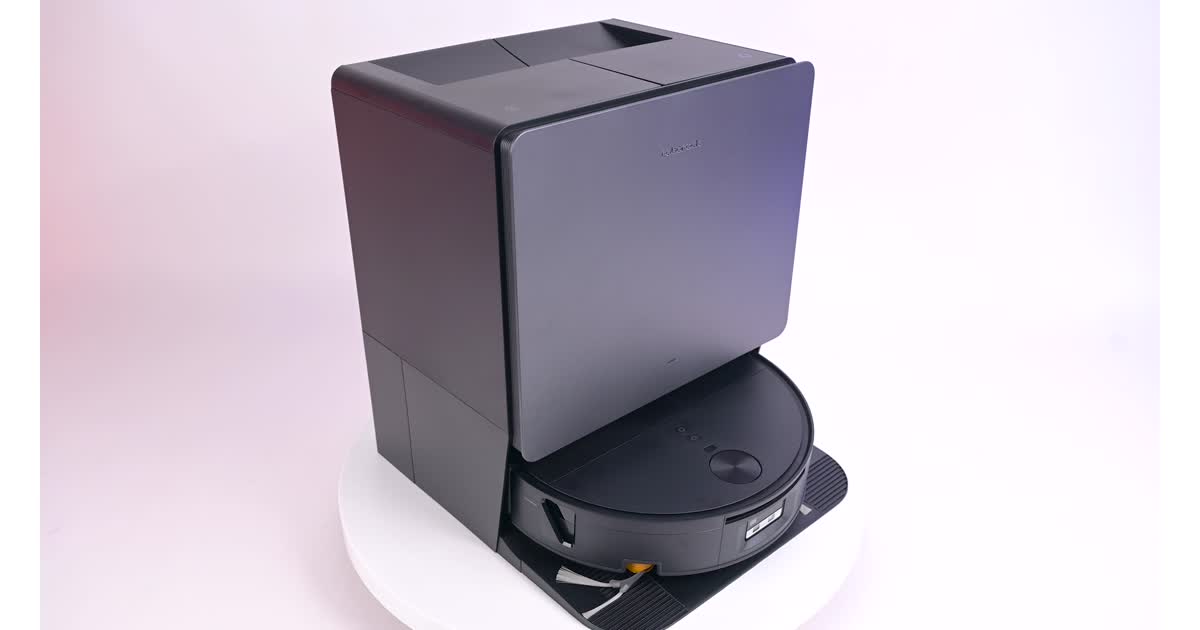
Roborock Saros 20 Flow Overview
Roborock’s Saros lineup represents its premium robot vacuum range, and the Saros 20 family includes three models with distinct mopping systems:
- the Saros 20 Flow uses a self-cleaning roller mop
- the Saros 20 Sonic (see our review) uses a vibrating mop pad
- the regular Saros 20 (see our review) uses two spinning mop pads
The Flow’s roller design cleans itself with fresh water and collects used water separately during cleaning. This may appeal to households dealing with wet messes, but preventing dirty water from spreading and removing stubborn dried-on stains are different challenges. Our testing showed that the Flow handled the former better than the latter.
Mopping Performance: A Different Approach With Mixed Results
Mopping is the Saros 20 Flow’s defining feature, but it was also the area where we found its biggest limitation. In our coffee-only dried-stain test, the Flow scored 53 points, ahead of the Sonic’s 41 but well behind the regular Saros 20’s 116. In our standard coffee-and-grape-juice stain test, the Flow scored 86 points, compared with 115 for the regular Saros 20 and 62 for the Sonic.
| Mopping test | Saros 20 Flow | Saros 20 | Saros 20 Sonic |
|---|---|---|---|
| Coffee-only stain test (points) | 53 | 116 | 41 |
| Coffee and grape juice (points) | 86 | 115 | 62 |
| Water left behind (g) | 0.37 | 0.70 | 0.73 |
| Combined mopping score (points) | 25.6 | 34.5 | 18.3 |
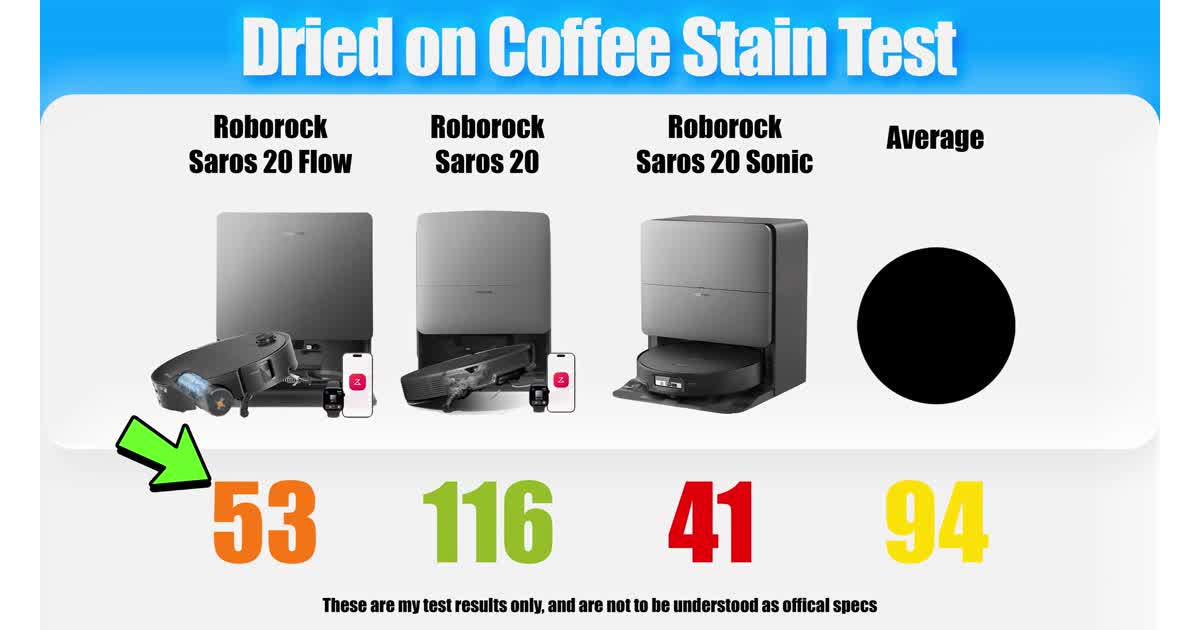
The Flow performed better in our water penalty test, leaving only 0.37 grams of water behind. The other two models left approximately twice that amount, although all three were below our studio average of 1.15 grams. Its combined mopping score of 25.6 was slightly above our average of 24.2, a relatively modest showing for a premium robot vacuum.
The Flow is suitable for routine floor cleaning, and its ability to collect dirty water as it goes may be more valuable in homes where wet messes are common. For buyers mainly concerned with stubborn dried stains, our results favor the regular Saros 20.
Vacuuming Performance: Strong Everyday Pickup
The Flow handled debris of different sizes on hard floors and carpets effectively, with minimal scattering of fine debris. In our carpet deep-clean test, which measures recovery of embedded sand, it achieved 89%. That matched the regular Saros 20 and came close to the Sonic’s 92%; all three exceeded our studio average of 78%.
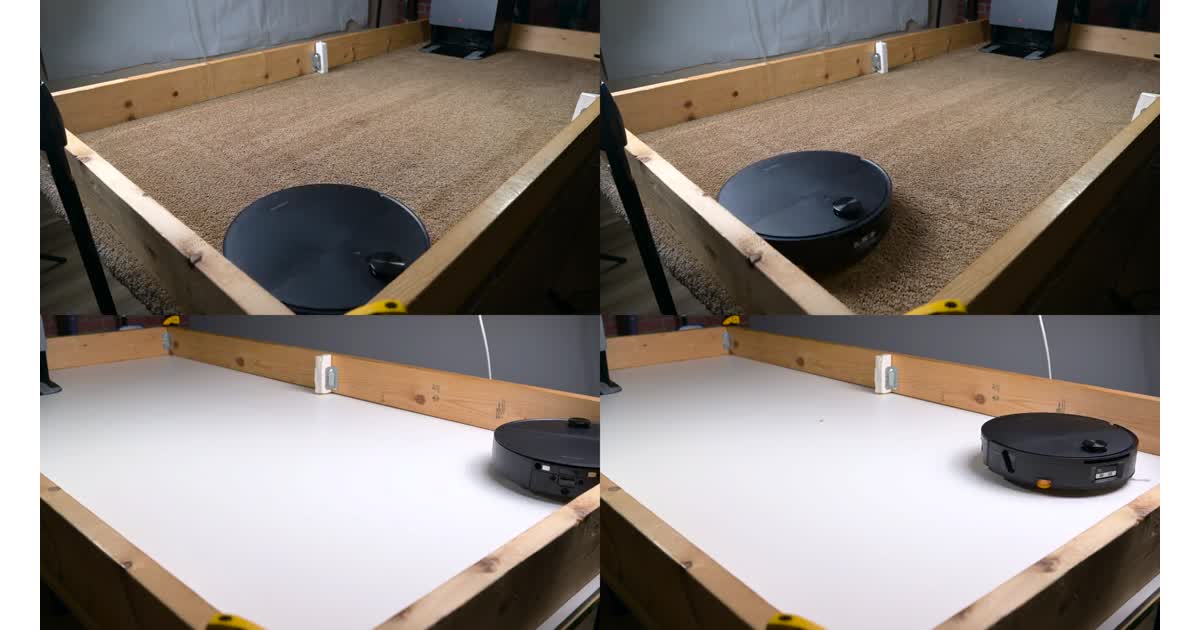
The Flow also had the strongest crevice-cleaning result of the three, although its 1-point score remained below our average of 1.97 points. Measured suction was 0.62 kPa, below the 0.99 kPa studio average, but airflow reached 20 CFM compared with 15 CFM for each of the other Saros models and an average of 17 CFM. These results illustrate why we assess practical cleaning performance using multiple tests rather than suction alone.
How Vacuum Wars Tests Robot Vacuums: Step into the world of Vacuum Wars, where real-world tests, straight-forward reviews, and no sponsored products redefine robot vacuum evaluations.
Hair Pickup and Anti-Tangle Performance
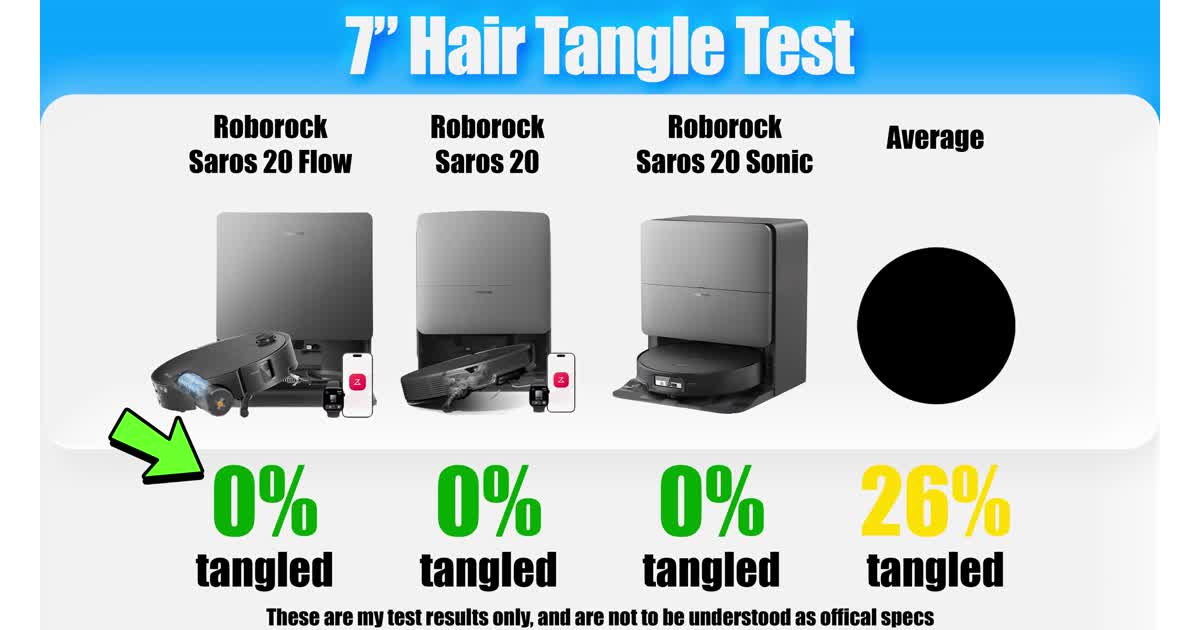
The Saros 20 Flow uses Roborock’s DuoDivide main brush system, also found on the other two models. All three finished our seven-inch hair-tangle test with no hair wrapped around the brushes or axles, a particularly useful result for homes with longer hair.
Flattened pet-hair pickup was less impressive. We press 2.5-inch hair into carpet to simulate hair that has been walked on; the Flow recovered 76%, compared with 78% for the Sonic and 88% for the regular Saros 20. Our studio average was 82%. The different mopping hardware might affect brush agitation, but that explanation is speculative, not something our tests established.
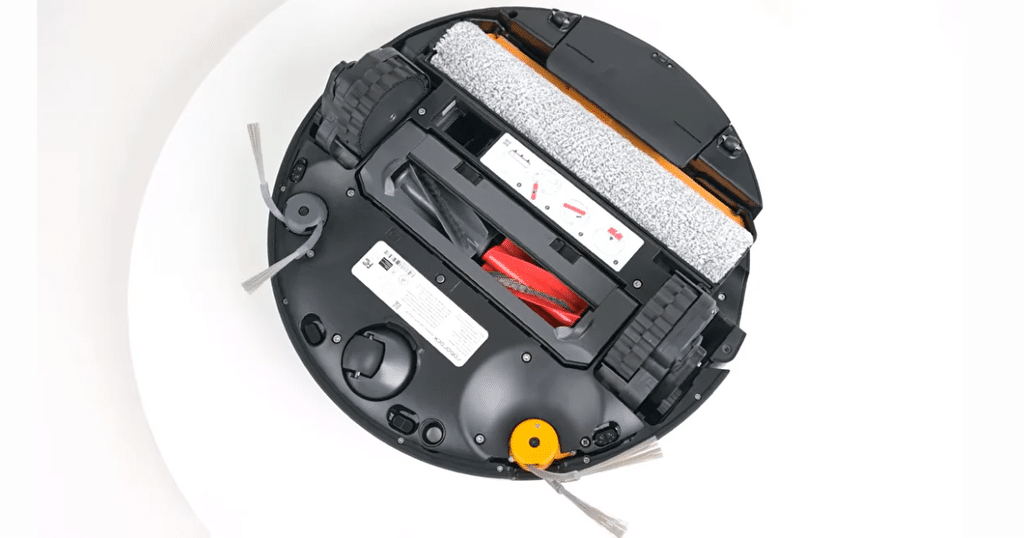
The Flow also uses two side brushes instead of one. Rather than extending outward, one of its side brushes reverses direction to reach deeper into corners.
Navigation and Battery Efficiency: A Major Strength
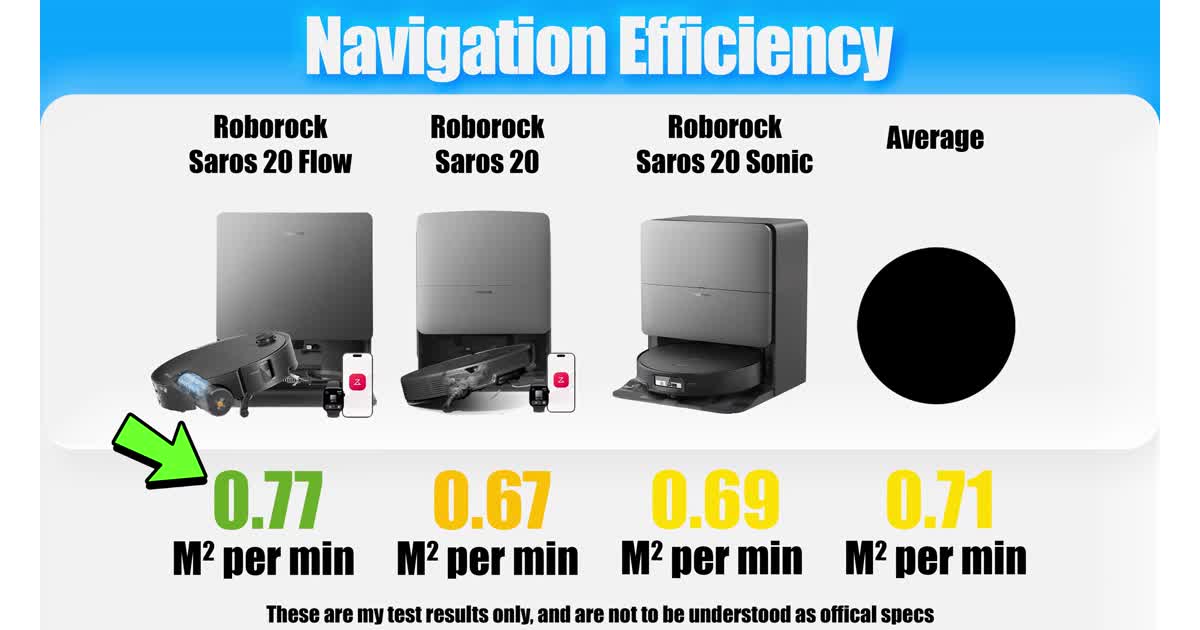
Navigation was one of the Flow’s clearest advantages. Its navigation efficiency measured 0.77 square meters per minute, compared with 0.67 for the Saros 20 and 0.69 for the Sonic. It finished our studio floorplan’s vacuum-and-mop run in 42 minutes, versus 50 and 49 minutes respectively.
The Flow averaged 1.72 minutes of operation per 1% of battery capacity consumed, exceeding our studio average of 1.56. Its navigation and battery results yielded an estimated coverage of approximately 1,420 square feet per charge—the highest of the three and above our average of 1,170.
| Navigation measurement | Saros 20 Flow | Saros 20 | Saros 20 Sonic |
|---|---|---|---|
| Navigation efficiency (m²/min) | 0.77 | 0.67 | 0.69 |
| Total vacuum-and-mop time (min) | 42 | 50 | 49 |
| Estimated coverage per charge (sq ft) | 1,420 | 1,040 | 1,230 |
These measurements make the Flow worth considering for larger floor plans or households that prioritize completing cleaning routines efficiently. Coverage estimates are derived from our studio testing and are not guaranteed results for every home.
Threshold Climbing and Low-Furniture Clearance
Roborock advertises double-layer threshold climbing up to 88 millimeters for the Flow, divided into a 45-millimeter first step and a 43-millimeter second step. All three Saros 20 models crossed a 57-millimeter single threshold in our studio testing.
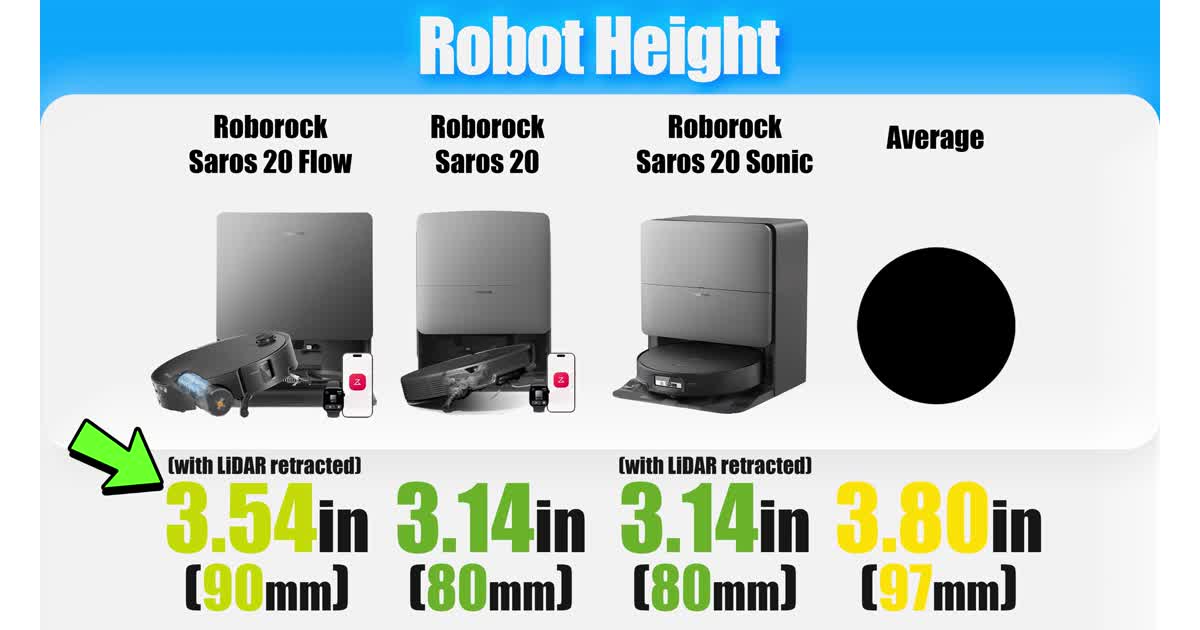
The Flow does give up some of the other models’ low-profile appeal. Roborock specifies a height of 3.54 inches with its LiDAR retracted, compared with approximately 3.14 inches for the Saros 20 and Sonic. It is still below our studio average of 3.80 inches, but the difference may matter beneath low furniture.
Self-Cleaning Dock and Carpet Protection
The Flow’s multifunction dock empties the robot’s dustbin into a disposable bag, washes the roller with hot water, dries it with warm air, refills the onboard clean-water tank, handles dirty water, and dispenses detergent automatically. The mop wash tray is removable for cleaning.
Unlike the regular Saros 20 and Sonic, the Flow does not leave its mop behind in the dock for vacuum-only cleaning. Roborock specifies a 15-millimeter roller lift and protective shield to help keep the mop away from carpeting. The app also allows carpets to be avoided altogether when mopping.
App Features and Smart Controls
The app includes room and zone cleaning, individualized room settings, no-go and no-mop zones, multi-floor maps, and recharge-and-resume functionality. Live-video and pet-check features are also available, along with the option to clean in the direction of the flooring pattern to minimize streaks.
Obstacle Avoidance: Adequate but Not Exceptional
The Flow scored 16 out of 24 in our obstacle avoidance test, effectively matching our studio average of 15.7. The standard Saros 20 scored 17, while the Sonic scored 19. An average result is not inherently poor, but we would like stronger avoidance from a premium flagship. It is still sensible to remove problem clutter before a cleaning run.
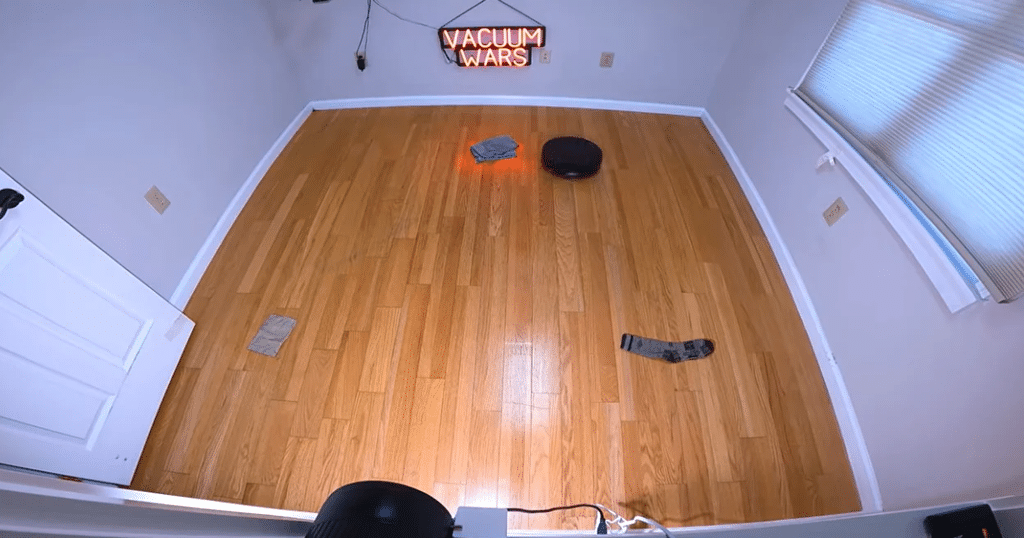
Roborock Saros 20 Flow vs. Saros 20 vs. Saros 20 Sonic
The Saros 20 Flow offers the quickest navigation, highest estimated coverage per charge, and least water left behind in our mop testing. Its roller design makes it distinctive for wet-mess handling.
The regular Saros 20 delivered the strongest flattened pet-hair pickup and the best overall mopping performance of the three, while keeping a slimmer body and matching the Flow in carpet deep cleaning.
The Saros 20 Sonic had the highest carpet deep-cleaning and obstacle-avoidance results, but its weaker mopping results made it less compelling as an all-around option in our assessment.
Is the Roborock Saros 20 Flow Worth It?
The Saros 20 Flow is a capable premium robot vacuum. Everyday debris pickup was strong, carpet deep cleaning was above average, tangle resistance was excellent, and navigation was the best of the three Saros 20 models. Its roller mop may especially suit households prioritizing wet-mess collection and low residual water.
However, dried-stain cleaning was weaker than we would expect from a premium model, and flattened carpet-hair pickup was below average. The taller body and merely average obstacle-avoidance score are additional considerations.
For most buyers choosing among these three models, we recommend the regular Saros 20. It delivered the stronger overall combination of vacuuming and mopping, particularly for carpet hair and dried-on stains. Choose the Flow when its roller-mop approach, faster navigation, or higher estimated coverage are more important to your household.
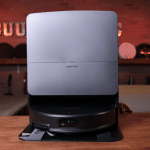
Roborock Saros 20
Vacuum Wars Stars 3.81
The Roborock Saros 20 is a premium flagship robot vacuum with standout cleaning performance, advanced automation features, and impressive obstacle handling. Its dual spinning mop pads operate at 200 RPM with adaptive pressure up to 13N, delivering above-average stain removal while using less water than average, which helped reduce streaking during testing. Vacuuming performance was also strong, with its 36,000Pa suction system clearing debris effectively on hard floors and carpets. In Vacuum Wars testing, it removed 89% of embedded sand in carpet deep-clean tests and picked up 88% of flattened pet hair, while the DuoDivide anti-tangle brush earned a perfect score in the 7-inch hair tangle test. Obstacle avoidance was above average, successfully avoiding 17 of 24 objects, and its Adaptive Lift 3.0 system crossed a record-setting 57mm threshold while maintaining a slim 3.13-inch profile. Additional highlights include boiling-water mop washing, hot-air drying, detergent dispensing, fast charging, automatic mop removal, Matter support, and a feature-rich app. Downsides include average navigation efficiency, slightly below-average battery life, average airflow and suction bench scores, and a relatively small dustbin that may fill quickly in pet-heavy homes. See additional info
Our comparison reflects our studio testing. Long-term customer feedback on this newer model is still limited, and rankings may change as additional information becomes available. See our latest Top 20 Robot Vacuum list for current recommendations.
Browse by category
Find the right robot for your home
Every list below is drawn from the same test data as this ranking.
By need
Mop CombosRobots that vacuum and mop in one pass, ranked by our 14 stain test.
Without MoppingVacuum only robots that give up nothing on carpet performance.
Obstacle AvoidanceThe robots that scored highest in our obstacle avoidance tests.
Pet HairTop pickup scores paired with genuine anti tangle brush rolls.
Hardwood Floors · soonComing as we finish the hard floor and water penalty round.
Large Homes · soonComing as we finish battery and coverage efficiency testing.
By price
Roborock Saros 20 Flow