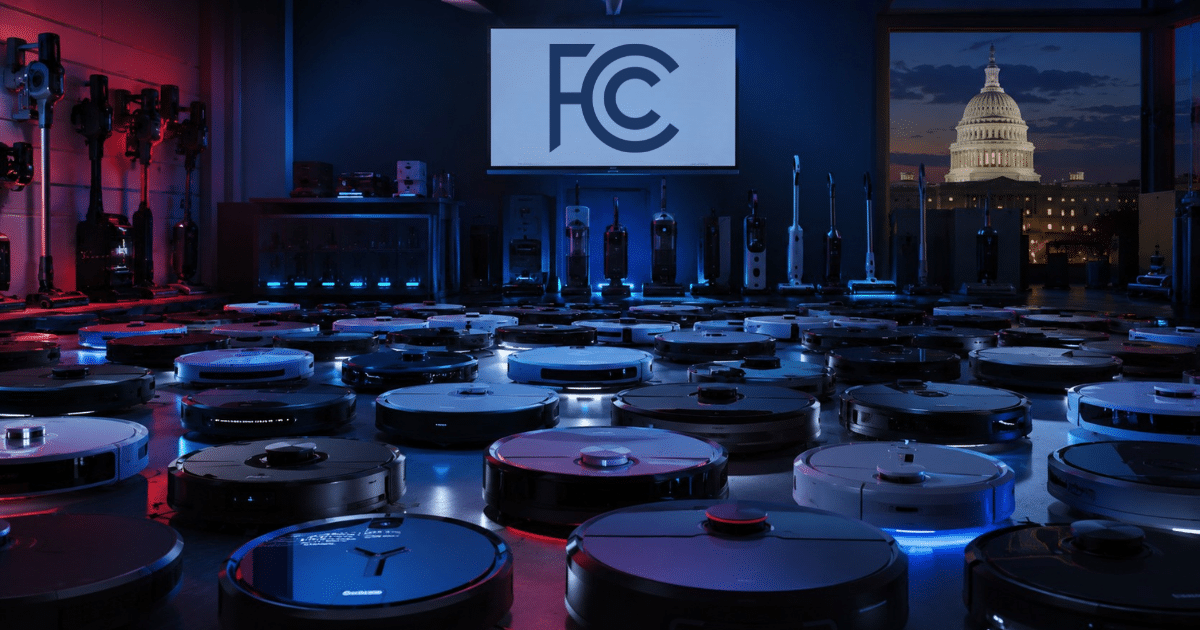
The Federal Communications Commission’s new restrictions on certain foreign-produced robotic devices are drawing two notably different responses from the robotics industry.
Robot vacuum brands are primarily reassuring customers that products already authorized and sold in the United States remain available and supported. Meanwhile, several U.S. robotics companies and policy organizations are welcoming the FCC’s action as a step toward strengthening domestic manufacturing and protecting technology supply chains.
Vacuum Wars contacted robot vacuum manufacturers and other organizations connected to the robotics industry for their response. The statements received so far show broad agreement about current products, but few concrete details about how companies will handle future U.S. releases.
Brands Reassure Current Customers
ECOVACS, Eufy, Narwal, and Shark all said that their current U.S. products remain available for sale, use, and support.
ECOVACS said:
“We are aware of the FCC’s action and are closely monitoring the latest developments. Based on our current understanding, there is no impact on existing ECOVACS customers in the U.S. or on products that have already received the necessary authorizations.
We remain committed to serving consumers in the U.S. and will continue to closely monitor regulatory developments. We will assess any potential implications and pursue opportunities to continue serving the U.S. market in compliance with applicable regulations.”
Eufy likewise emphasized that products it currently sells in the United States will remain available and supported:
“We are aware of the FCC’s recent update. Based on our current understanding, the new rule does not affect the continued availability, use or support of products we currently sell in the United States. Those products remain available and will continue to receive updates and customer support.
Like others across the industry, we are seeking further clarity on how the rule will be applied to future products, and we will keep our customers informed. We remain committed to complying with all regulatory requirements in every market where we operate
Narwal said its existing U.S. products are unaffected and confirmed that it is reviewing the FCC’s Conditional Approval process:
“Narwal products already certified and sold in the United States are not affected by the FCC’s action. Our customers’ robots continue to work, remain fully supported, and current models remain available at retail. We are reviewing the announcement and the conditional approval process, and we remain committed to serving our U.S. consumers. The security and privacy of our customers’ homes is foundational to the ethos of the Narwal brand, and we welcome the opportunity to demonstrate that.”
Shark also confirmed continued availability and support for its current robot vacuums while expressing confidence about its ability to introduce future models:
“Our Shark robot vacuums currently sold in the U.S. will continue to be available for sale, use and support. Regarding future models, we are evaluating our best options, but as a U.S.-based company we believe we are well positioned to navigate the process to continue to launch new models at competitive prices as we always have. We are closely monitoring developments and evaluating next steps as more information becomes available. We remain committed to serving our consumers and keeping them informed.”
Taken together, the statements offer a consistent message: current customers and existing products are not affected, while manufacturers are still reviewing how the FCC’s action may apply to future models. None of the responding companies announced a specific change to its U.S. product plans.
Robotics Companies and Policy Organizations Support the FCC’s Action
While consumer robot vacuum brands have focused on continuity and compliance, several U.S. robotics companies and policy organizations expressed support for the FCC’s action in a collection of stakeholder reactions published by the office of FCC Chairman Brendan Carr.
In the FCC chairman’s collection of stakeholder reactions, Evan Beard, CEO of Standard Bots, described the policy as a significant technology-security measure:
“This is one of the strongest technology-security actions in modern U.S. history. The message is unambiguous: robotics is a technology America must lead and own—and foreign-subsidized robots will not be allowed to unfairly dominate U.S. robotics as they did solar.”
Matic, a U.S. consumer robotics company, said in the same FCC publication that the action could support domestic robotics manufacturing and supply-chain development:
“This action by the FCC will help ensure America can design, engineer, and build all manner of robots at scale. This is particularly important to us at Matic, as our mission is to build secure consumer robots that help Americans at home, and manufacture them here in America.
Consumer robots are rapidly evolving from floor-cleaners to broadly-capable household assistants, and are also where robotics manufacturing reaches scale. The supply chains necessary for consumer robots are the same ones defense, industrial, and healthcare robots will depend on. We commend Chairman Carr and the Commission for acting while this industry is still taking shape, and we are eager to help make America a robotics manufacturing powerhouse.”
August 20, 2026 Update: Since those reactions were published, Matic has provided additional context about its own manufacturing position. Co-founder Mehul Nariyawala told Forbes that although Matic designs and assembles its robots in the United States, the company does not currently meet the 65% domestic-component benchmark associated with the FCC framework. Read more: Matic Says It Does Not Yet Meet FCC’s 65% U.S.-Content Threshold
The New American Industrial Alliance also supported the expansion of the FCC’s Covered List in the agency’s collection of stakeholder reactions:
“NAIA supports the Federal Communications Commission’s broadening of the Covered List to include advanced robotics devices and connected power inverters as prohibited categories. It’s critical to protect our supply chains from foreign interference and this expansion will continue that effort. We thank the FCC for their leadership.”
Joel Thayer, president of the Digital Progress Institute, described Conditional Approval as a measured approach in the FCC publication:
“The Conditional Approval mechanism is the appropriate, incremental approach to target these types of risk, while not inhibiting innovation and avoiding any disruption to existing consumer devices or federal procurement.”
These statements were included in a July 30 publication from the office of FCC Chairman Brendan Carr compiling reactions from elected officials, companies, trade groups, and policy organizations that supported the agency’s action.
What Comes Next
The responses show broad agreement that current robot vacuum owners should not face immediate disruption. Existing products remain available and supported, but manufacturers are offering few specifics about how they will approach future U.S. releases.
Vacuum Wars has contacted additional robot vacuum manufacturers and will update this article as more statements and concrete plans become available.
More Vacuum Wars Coverage of the FCC Action
Matic Robot Floor Cleaner Granted Conditional Exemption From FCC Covered List – October 5, 2026
Narwal CEO Junbin Zhang Explains How Dual-Fisheye Vision and NarMind AI Are Changing Robot Vacuums – September 9, 2026
Matic Says It Does Not Yet Meet FCC’s 65% U.S.-Content Threshold – August 20, 2026
What the FCC’s New Robot Vacuum Rules Could Mean for Future Manufacturing – August 7, 2026
Why Is the U.S. Restricting New Foreign Robot Vacuums? – August 4, 2026
Robot Vacuum Brands Respond to FCC Restrictions as U.S. Robotics Groups Voice Support – August 4, 2026
Conditional Approval for Future Foreign-Produced Robot Vacuums – August 4, 2026
Will Your Robot Vacuum Still Work? What the FCC’s New Rules Mean – August 3, 2026
America’s Robot Vacuum Ban: What You Need to Know – July 30, 2026
Robot Vacuum Security: What Users Should Know
Learn how cameras, microphones, mapping data, cloud connections, and software vulnerabilities can affect robot vacuum privacy and security.
Browse by Category
Jump to our tested picks for each type of robot vacuum, or compare any two or three robots head-to-head using our comparison tool.