
Matic, the U.S. consumer robotics company that designs and assembles its floor-cleaning robot in California, says it does not currently meet the 65% domestic-component threshold associated with the Federal Communications Commission’s new restrictions on foreign-produced advanced robotic devices.
The disclosure appeared in an August 18 Forbes interview with Matic co-founder Mehul Nariyawala. It provides one of the clearest real-world examples yet of the manufacturing challenge created by the FCC’s new framework: even a robot designed and assembled in the United States may not necessarily qualify as a domestic end product.
Matic’s Position on the FCC Restrictions
Matic has previously expressed support for the FCC’s action. As covered in our article on robot vacuum brands’ responses to the new restrictions, the company said the policy could help the United States develop the manufacturing capacity and supply chains needed for consumer, industrial, healthcare, and defense robots.
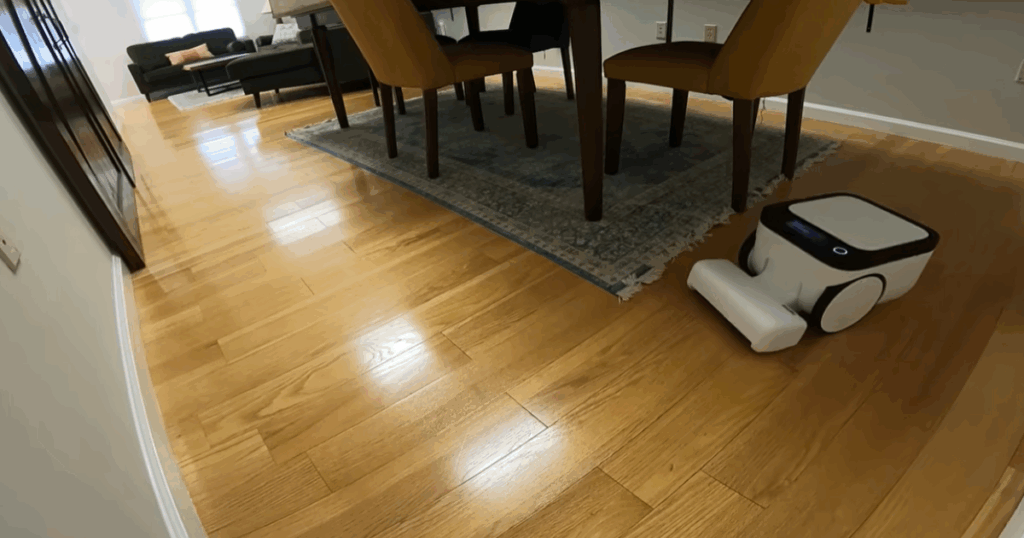
Matic’s floor-cleaning robot (see our review) is designed, tested, assembled, and supported in Mountain View, California. The company also acknowledges on its website that the robot’s components come from multiple countries.
In the Forbes interview, Nariyawala told Forbes that Matic currently designs and assembles its robots in the U.S. but does not meet the 65% component-sourcing benchmark. He added that Matic still has work to do to meet the government’s guidelines and described the effort as a step in the right direction for American families.
The statement does not mean that Matic’s California assembly claim is inaccurate. Instead, it illustrates the difference between assembling a product in the United States and meeting a federal domestic-content test.
Why U.S. Assembly May Not Be Enough
The FCC added foreign-produced advanced robotic devices to its Covered List on July 28, 2026. The covered category includes mobile robots with autonomous navigation, environmental sensors, network connectivity, and other characteristics common to modern robot vacuums.
As we explained in our recent look at what the FCC rules could mean for American robot vacuum manufacturing, the framework incorporates an existing federal definition of a “domestic end product.” Under the Federal Acquisition Regulation, a manufactured product generally must satisfy a two-part test: it must be manufactured in the United States, and the cost of its domestic components must exceed the applicable percentage of the total component cost.
That threshold is 65% for products delivered from 2024 through 2028. Under the current federal schedule, it increases to 75% beginning in 2029.
This is more demanding than simply moving final assembly to a U.S. facility. Robot vacuums combine batteries, motors, circuit boards, processors, cameras, sensors, wireless hardware, magnets, molded parts, and other components sourced through complex international supply chains. A company may perform its engineering, software development, testing, and assembly domestically while still relying on imported components for a substantial share of the robot’s total component cost.
Matic has not publicly disclosed its current domestic-content percentage or identified which components would need to be sourced differently to reach the 65% benchmark.
An Open Question About Consumer Products
There are still unresolved questions about how the FCC will apply the domestic-end-product definition to consumer robots.
The Federal Acquisition Regulation generally waives the domestic component-cost test for commercially available off-the-shelf products, commonly known as COTS items. It is not yet clear how that provision will be interpreted within the FCC’s framework for consumer robot vacuums.
Matic’s statement indicates that the company is treating the 65% benchmark as relevant to its planning. However, the disclosure does not resolve the broader question of whether every consumer robot seeking domestic-end-product status will ultimately be required to meet that component-cost calculation in the same way.
The FCC also provides a separate Conditional Approval route for foreign-produced advanced robotic devices. A manufacturer granted Conditional Approval may continue seeking equipment authorization while addressing national security concerns and presenting a plan for U.S. manufacturing. This means satisfying the domestic-content test is not necessarily the only possible path for a future robot model.
What This Means for Current Matic Owners
Matic’s statement should not be interpreted as meaning that its current robot has failed FCC authorization or must be removed from the U.S. market.
The FCC has said that its Covered List update does not prohibit consumers from continuing to use devices they already own. It also does not prevent retailers from selling or importing models that received FCC equipment authorization before the July 28 update. The most significant restrictions apply to new models seeking authorization after the change.
That distinction has been consistent across responses from robot vacuum manufacturers. ECOVACS, Eufy, Narwal, and Shark have all told Vacuum Wars that their existing U.S. products remain available and supported, while questions about future product generations are still being evaluated.
A Real-World Example of the Supply-Chain Challenge
Matic’s disclosure is notable because the company already has a more visible U.S. production footprint than many consumer robotics brands. It designs and assembles its robots in California and has publicly supported the FCC’s effort to expand domestic robotics manufacturing. Even so, it says it has not yet reached the current domestic-component threshold.
That does not establish how other manufacturers will fare under the new framework, and Matic has not released enough component-cost information for an independent comparison. It does, however, demonstrate why the transition is likely to involve much more than relocating a final assembly line.
For robot vacuum manufacturers, the larger challenge may be developing domestic sources for the batteries, motors, electronics, sensors, and other high-value components that determine whether a product meets the federal component-cost calculation. Some of those supply chains could take years to establish at the scale and pricing expected in the consumer market.
What Comes Next
Matic has said it intends to work toward meeting the federal guidelines, but it has not announced a timeline, a domestic-content target, or a specific compliance route for future hardware.
The first Conditional Approval decisions involving consumer robots may provide more clarity about how the FCC will evaluate manufacturing plans, component sourcing, cybersecurity, and supply-chain risk. Additional guidance could also help resolve how the domestic-end-product and COTS provisions will apply to robot vacuums.
For now, Matic’s disclosure reinforces an important point: a robot can be designed and assembled in the United States without yet meeting the federal definition of a domestic end product. It also offers an early indication of how difficult the FCC-driven manufacturing transition could be—even for a U.S. robotics company already assembling its products domestically.
More Vacuum Wars Coverage of the FCC Action
Matic Robot Floor Cleaner Granted Conditional Exemption From FCC Covered List – October 5, 2026
Narwal CEO Junbin Zhang Explains How Dual-Fisheye Vision and NarMind AI Are Changing Robot Vacuums – September 9, 2026
Matic Says It Does Not Yet Meet FCC’s 65% U.S.-Content Threshold – August 20, 2026
What the FCC’s New Robot Vacuum Rules Could Mean for Future Manufacturing – August 7, 2026
Why Is the U.S. Restricting New Foreign Robot Vacuums? – August 4, 2026
Robot Vacuum Brands Respond to FCC Restrictions as U.S. Robotics Groups Voice Support – August 4, 2026
Conditional Approval for Future Foreign-Produced Robot Vacuums – August 4, 2026
Will Your Robot Vacuum Still Work? What the FCC’s New Rules Mean – August 3, 2026
America’s Robot Vacuum Ban: What You Need to Know – July 30, 2026
Robot Vacuum Security: What Users Should Know
Learn how cameras, microphones, mapping data, cloud connections, and software vulnerabilities can affect robot vacuum privacy and security.
Browse by Category
Jump to our tested picks for each type of robot vacuum, or compare any two or three robots head-to-head using our comparison tool.